Split firewood stacked against the dark vertical board siding of a house, beside a gravel strip, an outdoor air conditioning unit, dry grass and pine trees.

Furnace Repair in Rupert, ID

Tell us about the job

Takes about a minute. No obligation.

RepairFurnace or heatingMinidoka County, ID
Step 1 of 2

What ZIP code is the job in?

Nine months of work a year

Furnaces around Rupert run from September through May. That's most of the year asking the igniter, the blower motor and the heat exchanger to cycle on and off, day after day, with barely a break before the next heating season starts.

What that means for your repair

A furnace with this little downtime wears parts out sooner than one that only runs a few months a year. When something breaks, it's often a part that gave out from use, not a one-time fluke. Getting the actual cause diagnosed matters more here than it would somewhere the furnace gets to rest half the year.

9 months
September through May, your furnace is on duty
18°F
the average winter night it heats against
28 winter storms
in ten years, the nights a failure hurts most
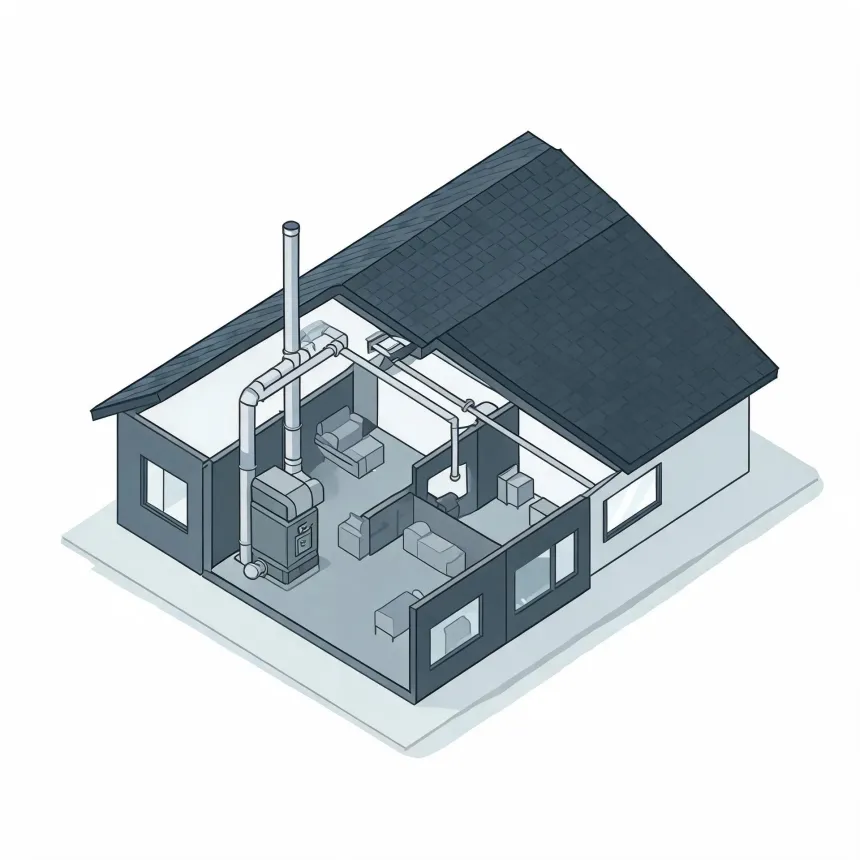
Isometric cutaway illustration of a single-story house showing interior rooms with furniture, a furnace unit connected to ducting and vertical flue pipes running through the roof.
Your furnace works hardest from November through March.

NOAA nClimDiv, 1991–2020 normals

Furnaces around Rupert sit idle most of August before the first cold nights in September put them back to work.

A part worn thin by last season's nine months often makes it through the summer quiet, then fails once the furnace is asked to run again.

Idaho's electricity costs add up fast when a furnace is running this much

Heat runs September through May
Winter nights average 18°F
Climate zone 5B

A furnace that's running rough doesn't get cheaper to ignore. It burns electricity doing it, and electricity in Idaho runs $33.76 per million Btu. A failing igniter, a blower motor pulling too hard, a heat exchanger making the system run longer to reach the same temperature, all of it shows up on the bill before it shows up as a full breakdown. Waiting on a repair doesn't pause the cost, it just lets it run up against a furnace that's already working hard. Getting a contractor out to diagnose it now is what stops that.

A furnace running nine months a year needs a real diagnosis, not a guess

When a part gives out from steady use, the fix that lasts is the one that starts with finding out which part it was. Get the furnace looked at before the rest of the season puts more load on whatever is already weak.

Find a contractor
A man in a dark shirt and tan work pants, seen from behind, carries a canvas tool bag up wooden steps toward a blue front door of a gray clapboard house, with a shrub in a blue planter beside the door.
A gas furnace with attached ductwork, gas piping, and condensate lines installed in a concrete-block basement.

Running it while it's broken breaks it further

A furnace that's struggling doesn't fix itself by staying on. Take a cracked heat exchanger. Left alone, it keeps flexing with every cycle, and the crack opens wider. Or a blower motor with a worn bearing. It'll keep spinning, but it's drawing harder to do the same job, and that strain is what burns it out for good. A dirty flame sensor will start by making the furnace shut off early. Ignore that, and the furnace just keeps retrying, short cycling, putting more wear on the igniter and the gas valve with every attempt. None of these get better with more run time. The part that's already failing is the one taking the load, cycle after cycle, and it's usually the next thing to go.

What you'll probably notice first

The air coming out of the vents turns lukewarm before it turns cold. The furnace clicks and tries to start but doesn't catch, or it catches and shuts off again a few seconds later. Some rooms stay cold no matter how long it runs. A burning smell on startup, a burnt dust smell that doesn't go away, or a sound that wasn't there before, a rattle, a squeal, a hard bang when it fires, all of these mean a part is past the point of just wearing normally.

What those signs are actually telling you

Short cycling usually points to a dirty flame sensor or a cracked heat exchanger tripping a safety switch. A squeal or grinding sound is a blower motor bearing giving out. A burning smell right at startup is often dust burning off the heat exchanger, but if it lingers, get it checked instead of waiting it out. None of these fix themselves by running longer. Each one points to a specific part, and that's what a contractor needs to know before touching anything.

Before calling anyone, check the thermostat batteries and make sure it's set to heat, not just fan. Check the air filter next. A filter clogged with dust chokes off airflow, and that alone can cause short cycling or weak heat at the vents. Go to the furnace and look at the switch on the side of it, the one that looks like a light switch. It needs to be on, and so does the power switch at the breaker panel. If it's got a standing pilot, check whether the pilot light is actually lit. None of this fixes a cracked heat exchanger or a failing blower motor, but it rules out the simple stuff before a contractor has to. If the furnace still won't run after all that, stop trying to restart it over and over. Each failed attempt is wear on the igniter and the gas valve for nothing.

A diagnostic visit starts with the thermostat and the basics, then moves to the furnace itself. A contractor will pull the panel and check the flame, watching how it lights and whether it stays lit through a full cycle. They'll test the flame sensor and the igniter directly rather than guessing from the symptoms, since a weak signal can look like several different problems from the vents. The blower gets checked too, both the motor and the wheel, because a motor can draw power and still not be moving enough air. If there's any sign of short cycling, they'll check the heat exchanger for cracks, since that's a safety issue and not just a comfort one. Most of this is testing with a meter and a trained eye, not swapping parts to see what helps. A real diagnosis ends with one answer, not a list of maybes.