A twilight street scene featuring illuminated timber-frame and stone houses with a mountain range visible in the background.

Furnace Repair in Rigby, ID

Tell us about the job

Takes about a minute. No obligation.

RepairFurnace or heatingJefferson County, ID
Step 1 of 2

What ZIP code is the job in?

Ten months of runtime

A furnace in Jefferson County runs from September through June most years. That's ten months out of twelve asking the igniter, the blower motor and the heat exchanger to cycle on and off, day after day. Parts built for average use don't get much of a break here.


What that means for the fix

A furnace that's barely rested for years can fail for more than one reason at once, so a quick guess at the problem can miss what's actually going on. Having it diagnosed properly, not just patched, is what makes the repair hold.

10 months
September through June, your furnace is on duty
11°F
the average winter night it heats against
58 winter storms
in ten years, the nights a failure hurts most
Isometric cutaway illustration of a single-story house showing interior rooms with a dark furnace unit, connected ductwork, a vertical flue pipe through the roof, and simple furniture, on a white background.
Your furnace works hardest from November through March.

NOAA nClimDiv, 1991–2020 normals

September is when furnaces here switch back on after sitting idle since spring.

A furnace that starts struggling in September was already weak going into summer, not failing because of it.

Half the furnaces here are younger than yours might be

Half the homes here were built by 1994
Heat runs September through June
Winter nights average 11°F

Natural gas in Idaho ran $8.25 per million Btu in 2024. A furnace that's short-cycling or running longer to reach the same temperature burns more of it every day it's left alone. A bad limit switch or a cracked heat exchanger doesn't just sit there quietly. It costs you on every cycle until someone fixes it. The longer it runs rough, the more that adds up before the repair even happens.

It's worked hard. Get it looked at properly

Ten months of runtime a year doesn't leave much room for a part to fail cleanly on its own. Get the actual cause checked before it gets patched over.

Find a contractor
A man in a cap, dark jacket and tan pants walks up porch steps toward a navy blue front door, carrying a canvas tool bag filled with hand tools, with a potted plant in a blue planter to the right.
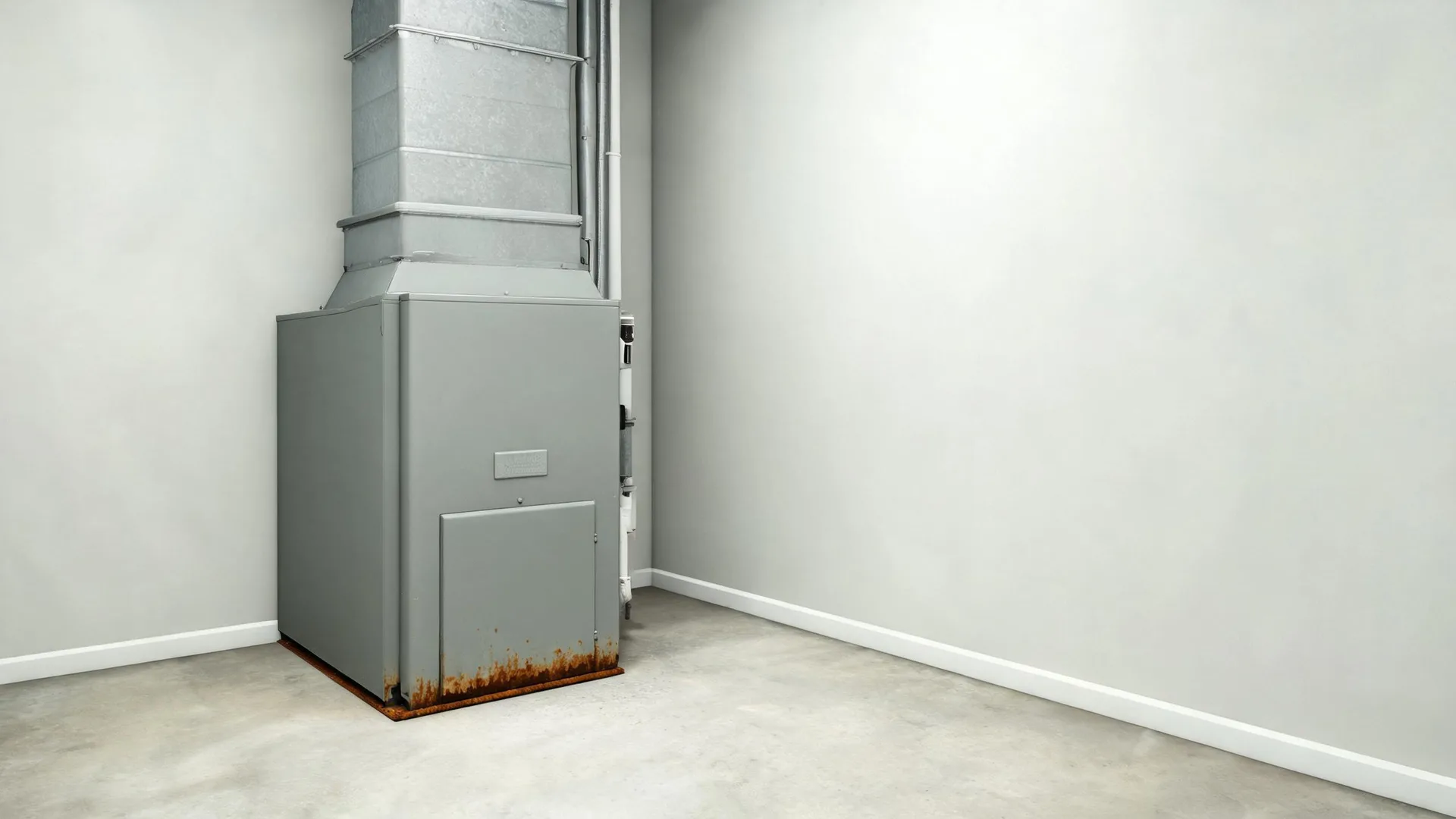
A gray residential gas furnace installed in an unfinished basement, connected to sheet-metal ductwork and PVC pipes.

If the house is newer, so is the furnace

If your furnace came with the house, check when that was built. Half the homes in the county went up in 1994 or later, so there's a decent chance yours is one of them. A furnace that age still has working life in it. A broken igniter or a dead blower motor on a system like that is a repair, not a reason to replace the whole unit.

Check the thermostat first

Make sure it's set to heat, not cool, and set a few degrees above room temperature. If the display is blank, the batteries might be dead. It sounds obvious, but a thermostat set wrong or out of power looks exactly like a dead furnace.

Look at the filter and the switches

Pull the filter and hold it up to a light. If you can't see light through it, swap it. A clogged filter starves the furnace of air and can shut it down on its own. While you're there, check that the power switch on the furnace itself is on and the breaker hasn't tripped. If it has a standing pilot, check whether the flame is lit before you call anyone.

An empty unfinished basement containing a forced-air furnace with overhead ductwork, exposed ceiling joists, and a single hanging light bulb.

A new furnace would cut about $100 a year off heating for a typical Jefferson County home.

  • A new high-efficiency furnace$410 a year
  • An older furnace$510 a year

Estimates for a typical Jefferson County home, compared with an older unit built to the previous federal minimum, from EIA household energy data, Idaho fuel prices and NOAA climate normals. Your home will differ.

Repair makes sense when one part has failed and the heat exchanger is sound.

Replacement makes sense when the heat exchanger is cracked or the furnace keeps needing parts.

A repair call usually comes down to one part. A failed igniter, a bad flame sensor, a blower motor that's seized: each of those is a known fix with a known part, and replacing it brings the furnace back to full working order. Replacement makes sense when the problem isn't really one part anymore. A cracked heat exchanger means the whole unit is done, since that part isn't sold on its own and isn't worth swapping even if it were. The harder calls are the ones in between, where a furnace that's needed two or three repairs in as many years starts costing more in parts and visits than it would to just replace. Age matters too, but only alongside how it's been running. A furnace that's heated evenly for years and just lost one part is worth fixing. One that's been struggling to keep up, running long cycles or short ones, has usually got more than one thing going wrong even if only one has failed so far.