Stone and timber luxury homes with glowing windows line a mountain street at dusk, with evergreen trees and a rocky mountain range in the background.

Furnace Repair in Council, ID

Tell us about the job

Takes about a minute. No obligation.

RepairFurnace or heatingAdams County, ID
Step 1 of 2

What ZIP code is the job in?

Ten months of heat a year

Furnaces in Council run from September through June most years, with overnight lows averaging 19°F in December, January and February. That's a long stretch of near-constant cycling, and the stretch keeps going during the hardest cold instead of easing up.

Breakdowns happen at the worst time

Adams County saw 48 winter storms between 2015 and 2024, heavy snow and ice included. A furnace that quits during one of those isn't a small inconvenience. Get a repair diagnosed properly rather than patched, so it holds up through the next storm instead of failing again.

10 months
September through June, your furnace is on duty
19°F
the average winter night it heats against
48 winter storms
in ten years, the nights a failure hurts most
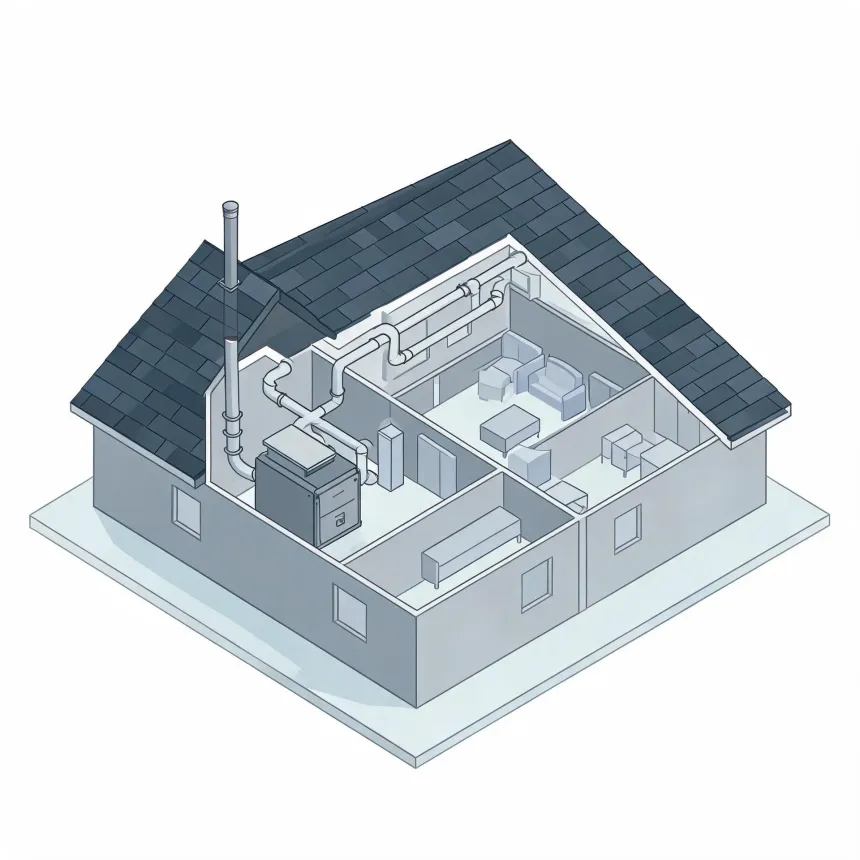
Isometric cutaway illustration of a single-story house with a dark shingled roof, showing interior rooms with furniture, ductwork, a flue pipe, and a furnace unit.
Your furnace works hardest from October through April.

NOAA nClimDiv, 1991–2020 normals

Furnaces in Council start their season in September.

The first cold snap finds whatever was already weak, so a furnace acting up early is worth checking before the ten months of heat wear it further.

Half the homes in Adams County were built since 1986, so most furnaces here are still well short of worn out

Half the homes here were built by 1986
Heat runs September through June
Winter nights average 19°F

If your furnace is short cycling or blowing cool air, don't wait to see if it sorts itself out. Heat here runs from September through June, and whatever's causing the trouble now has that whole stretch to get worse. A proper diagnosis finds the actual part at fault, a cracked igniter, a failing blower motor, a clogged flame sensor, rather than guessing. That matters more here because a patched repair that fails during a storm means waiting out the weather before anyone can get to you.

A newer furnace is a repair, not a replacement

A furnace that came in with a newer build has most of its working life still ahead of it. That's worth knowing before you decide whether to fix what's acting up or start pricing something new. Get the actual part diagnosed.

Find a contractor
A man in a cap, gray long-sleeve shirt and tan work pants carries a canvas tool bag up gray porch steps toward a dark blue front door, with a blue ceramic planter and shrub beside it.
A gas furnace with attached ductwork, gas piping, and condensate lines installed in a concrete-block basement.

What actually wears out

Most failures trace back to normal wear catching up with a part that's been working hard the whole season. The igniter is a common one. It heats up and cools down every single cycle, and that repeated stress eventually cracks it. A flame sensor gets a thin coating of oxidation over time and stops reading the flame, so the furnace shuts itself off as a safety measure even though nothing's really wrong with the flame. The blower motor wears on its bearings after enough hours of runtime and starts making noise before it quits outright. Flexing in the heat exchanger from constant expansion and contraction is another one, and that's not a part to leave alone since it separates the combustion gases from the air moving through your house. Pressure switches, capacitors, control boards, all of them have a working life, and constant cycling uses that life up faster than a system that only runs occasionally. None of this means a furnace is done for. It means something specific failed, and finding which part it was is the difference between a repair that holds and one that doesn't.

What you can check safely

Make sure the thermostat is set to heat and the setting is actually above room temperature. Check that the filter isn't clogged, since a blocked filter chokes airflow and can cause the furnace to shut itself off. Look at the switch on the furnace itself, the one that looks like a light switch on the side of the unit, and make sure it hasn't been bumped off. If the furnace uses a standing pilot, check whether the pilot light is still lit.

What to leave alone

Don't open the burner compartment or touch the heat exchanger, flame sensor or igniter. These sit close to live electrical connections and gas lines, and the flame sensor especially is easy to damage by cleaning it wrong. If the breaker trips more than once after you reset it, stop resetting it and leave that for a diagnosis instead of forcing it to run.

A furnace that's short cycling or struggling to light usually isn't failing all at once. It's one part working harder to cover for whatever's already wrong, and that extra strain is what turns a small problem into a bigger one. A cracked igniter that's intermittent now can fail completely after enough cycles of heating and cooling. A flame sensor with a little oxidation can build up more and trip the furnace off more often until it won't stay lit at all. Even a dirty filter left in place forces the blower to work against restricted airflow, and that added load shortens what's left of its life. Running the furnace through these problems doesn't give them a chance to resolve. It just adds more cycles of stress to a part that's already struggling.

A diagnostic visit starts with questions, not tools. What is the furnace doing, and when does it do it. Short cycling, a smell, a strange noise, a thermostat that never gets satisfied, each one points somewhere different. The filter and airflow get checked first, since restricted air causes problems that look like other failures. Then comes watching a full cycle to see exactly where things go wrong, whether it's ignition, flame sensing, or heat actually making it through the house. A multimeter checks what can't be judged by eye, things like the igniter's resistance or whether a safety switch is passing power the way it should. The point isn't to swap parts and hope. It's to find the one part causing the trouble, confirm it, and leave everything else alone.