Side profile of a bearded man wearing a faded dark blue baseball cap and a matching dark T-shirt against a plain light gray background.

When to replace a furnace in Pocatello, ID

New system or replacementFurnace or heatingBannock County, ID
Step 1 of 2

What ZIP code is the job in?

Most furnaces in Bannock County last 15 to 20 years, and age is the main thing to weigh. If yours is in that range and needs a repair, replacing it usually makes more sense than fixing it again. Winters here are hard, and a furnace that is struggling shows it in ways you can check yourself: it runs longer to hold the same temperature, cycles on and off more than it used to, or leaves some rooms colder than others. A rising gas bill with no other explanation is another sign the burner is working harder to do the same job. If the furnace is also starting to need a repair call every winter, the cost of those add up the same way a full replacement would. None of this means a furnace with a few years left needs to go. It means that once yours is old and starting to fail in these ways, waiting usually costs more than replacing it.

An older gas furnace with two louvered front panels stands on a concrete basement floor beside galvanized sheet-metal ductwork, pipes, and a weathered concrete wall.
Before you get your furnace installation
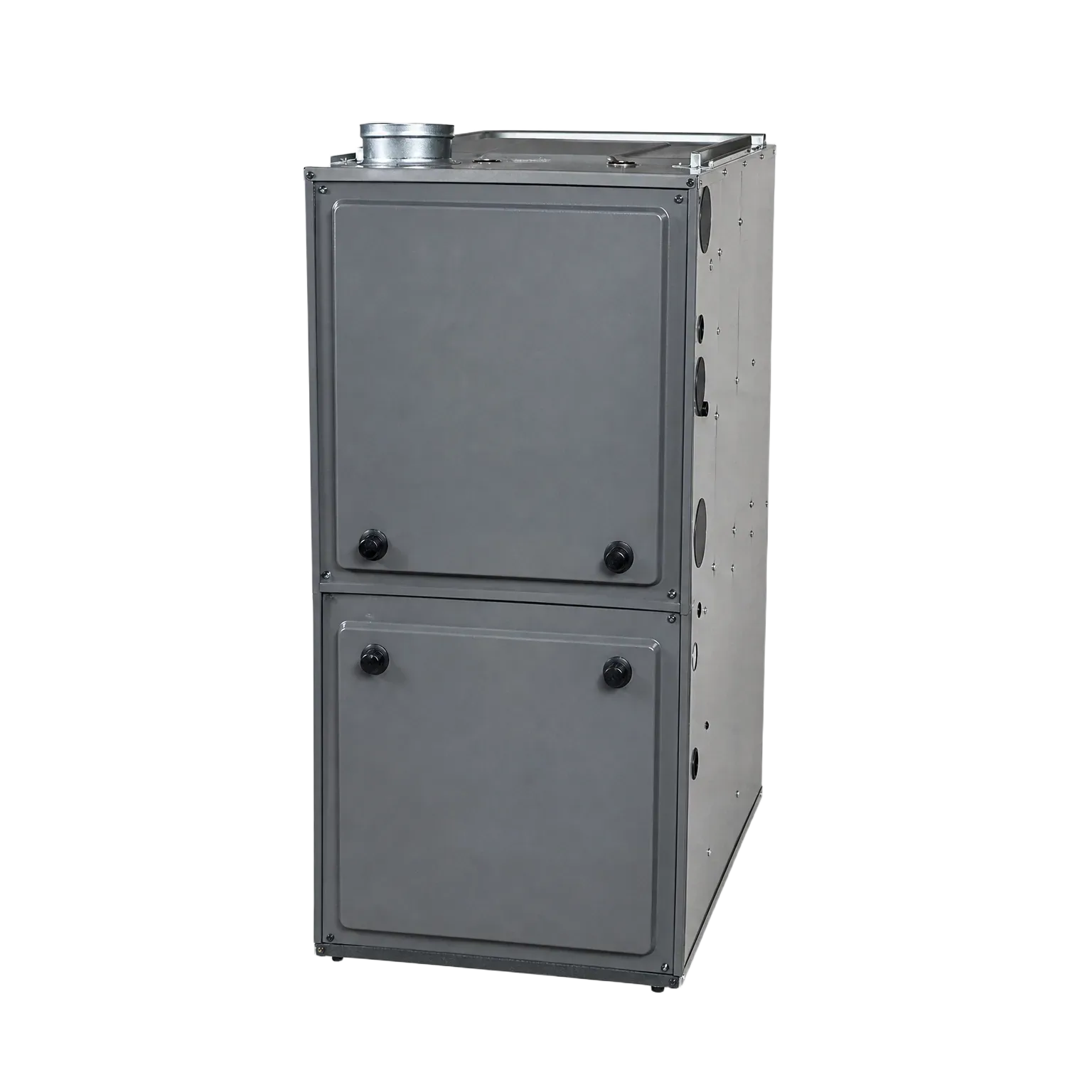
A gray high-efficiency furnace in a basement, connected to sheet-metal ductwork on the left and white PVC vent pipes above, with black gas and drain piping and an exposed wood-stud wall with OSB sheathing on the right.
After you get your furnace installation

A furnace rarely quits all at once. It gives signs first, and most of them point to one part, not the whole machine. Short cycling usually means the heat exchanger or the flame sensor is going, not that the filter needs changing. A furnace that won't light at all is often a cracked igniter, the part that replaced the old standing pilot in most gas furnaces now. The flame itself tells you something too. Steady blue is normal. Yellow or flickering means combustion isn't clean, and on an older unit that isn't something a repair fixes for good. The blower can keep running air through the house long after the heat exchanger starts to fail, so warm air coming out doesn't mean the furnace is fine. Soot near the vent pipe or a rising carbon monoxide reading means that exchanger has likely cracked, and at that point it's a safety call, not a comfort one. Even a furnace that never breaks down outright loses efficiency year over year, so an old one can cost more to run each winter just by still running.

What's Actually Failing Inside

  • A furnace that short cycles, turning on and off every few minutes, is usually failing the heat exchanger or a flame sensor rather than just a dirty filter.
  • Most gas furnaces fire with a hot surface igniter now, and a cracked igniter is one of the most common reasons a furnace won't start at all.
  • A yellow or flickering flame instead of a steady blue one points to a combustion problem that a repair won't permanently fix on an aging unit.
  • The blower motor usually outlasts the heat exchanger, so a furnace can still move air while the part that actually heats it is failing.
  • Rising carbon monoxide readings or soot near the vent pipe mean the heat exchanger has likely cracked, and that is a safety issue, not just a comfort one.
  • Furnaces lose efficiency as they age even without breaking down, so an 18 year old furnace can cost more to run every winter than a new one.
A woman with long light-brown hair in a gray knit sweater sits in a living room looking off to the side, with a sectional sofa, houseplant, lamp, wooden table and large windows behind her.
A woman in a chunky gray turtleneck sweater sits indoors looking off to the side, with a blurred dining table, chairs, pendant lamp and window behind her.
A woman in a cream knit sweater with her hair in a bun stands near a window, looking off to the side, with a gray sofa, houseplant and open kitchen with pendant lights blurred behind her.
A woman with long brown hair in a cream knit sweater stands near a window, looking to the side, with a white sofa, shelving, and a hallway visible behind her.

Bannock County winters run below freezing for weeks at a stretch, and a furnace near the end of its life has to run longer each cycle to keep up.

That extra runtime wears the same aging parts faster, which is why the breakdowns tend to bunch up in the coldest months instead of spreading out evenly over the year.

How cold and how long does your furnace really work here?

  • Winter nights average 18°F

    Nights this cold mean your furnace runs long cycles for weeks straight, and an older unit has to push harder each time to keep the house livable.

  • Heat runs September through June

    Ten months of the year, your furnace is the thing standing between your house and the cold. That is a long stretch for a system in its last years to carry.

  • 58.9% of homes heat with gas

    Most of your neighbors heat with gas, same as you probably do. Parts and know-how for gas furnaces are what contractors here see and stock most.

NOAA nClimDiv 1991-2020 · ACS 2020-2024

A gray high-efficiency furnace with white PVC vent pipes stands against a concrete basement wall beside sheet-metal ductwork, a small condensate pump on the floor, and exposed wood framing at left.

Running the way it should

A furnace like this heats evenly and holds its cycle without strain. The flue pipes and ductwork are tight, the burner fires clean, and the area around it stays dry. Nothing about it needs your attention, which is exactly what you want from a furnace in January.

A gray sheet-metal furnace with flue pipe and adjacent ductwork stands against a stone basement wall on a concrete floor, with white PVC and metal pipes running nearby.

Working harder than it should

An older furnace like this has gas lines, patched tubing and a mechanical room that has seen years of wear. It can still run, but it leans on parts that are tired and in a space that shows its age. When it finally gives out, it tends to be on the coldest night you've had.

Repair the Furnace or Replace It

Repair

  • A cracked heat exchanger or a bad igniter can usually be swapped out in a single visit without touching the rest of the system.
  • If your furnace is under 15 years old, a repair now likely buys you several more winters before anything else goes.
  • One repair on a furnace that's otherwise sound costs less upfront than replacing the whole unit.
  • If this is the first issue the furnace has had, there's no pattern yet telling you it's wearing out overall.
  • A furnace that's been maintained and just hit one failed part is a reasonable candidate for fixing rather than pulling out.

Replace

  • A furnace past 15 to 20 years that needs a repair is likely to need another one soon, since the parts around it are aging too.
  • If this is the second or third repair in a few winters, the pattern matters more than any single fix.
  • A new furnace won't leave you guessing whether it holds up through a full Bannock County winter.
  • Replacing before a full breakdown means you're not without heat during the coldest stretch of the year while parts get ordered.
  • If the repair needed is on the heat exchanger itself, that's often the point where replacing makes more sense than fixing.
  • A newer furnace runs shorter, steadier cycles instead of straining to keep up the way an aging one does.
  1. Thermostat calls for heat and signals the control board.

  2. Inducer motor starts and clears the heat exchanger.

  3. Hot surface igniter glows and ignites the gas burners.

  4. Flame sensor confirms burn, keeping gas flowing steadily.

A woman and a child wrapped together in a thick knitted beige blanket on a sofa, both with eyes closed, beside a lit table lamp in a dim room.
A smiling older woman with gray hair in a loose bun wearing a ribbed beige sweater stands in a dimly lit kitchen beside a window showing darkness outside, with a loaf of crusty bread on a wooden board in the foreground.

Done looking for a furnace pro

A licensed installer who works in Bannock County gets your project.

There's no charge for the request.

What a failing furnace costs you

An aging furnace does not fail evenly across the house. Rooms farthest from the furnace start running cold first, and you end up closing doors or running space heaters to make up the difference. Gas burns the same whether the heat exchanger is cracked or not, so the bill does not drop with the comfort. Some homes see it in the register temperature, air that used to come out hot now comes out warm. Others notice the furnace running almost constantly through a cold snap instead of cycling off. None of this damages anything beyond the furnace itself, but it is the house telling you the equipment is behind on the work it used to do without strain.

What happens if it quits

A furnace that dies in January does not give you time to shop around. Bannock County stays below freezing for stretches long enough that pipes are at risk within a day or two of the heat going out, especially in rooms on outside walls. If your furnace is already in its late teens and showing signs, that risk is worth planning around rather than waiting on. Replacing it on your schedule, before a cold night forces the decision, means you pick the unit and the install date instead of taking whatever can be arranged in an emergency. Waiting costs you that choice, not just comfort.

Winter nights average 18°F

An 18°F night is a long cycle, not a quick one. Your furnace has to keep pushing heat for hours to hold the house steady, and it does that most nights from December through February. A furnace near the end of its life feels that kind of night first.

NOAA nClimDiv 1991-2020

A gray gas furnace stands on a concrete basement floor, connected to sheet-metal ductwork, white PVC vent pipes, and a yellow gas line, with plastic sheeting covering the walls.
A furnace like this is doing its job without a fight, venting clean through tight PVC and running on a setup built to last.
A metal furnace with louvered panels stands against a concrete basement wall, connected to sheet-metal ductwork and a round flue pipe, with wooden framing posts and a pipe nearby.
This one has years of dust and wear on it, and in an unfinished basement that age shows fast once a part starts to go.

Where Your Furnace Stands

  • A furnace past 15 years that needs a repair in the middle of a Pocatello winter is usually better replaced than patched again.
  • A cracked heat exchanger or a failing control board on an older unit is a sign to plan replacement, not just fix the one part.
  • Waiting until a furnace quits on one of the coldest nights leaves you without heat exactly when you need it most.
  • A licensed local contractor who services furnaces around Bannock County every winter knows which models and parts tend to fail first.
  • Submitting one request connects you with one contractor suited to your furnace, not a string of calls from companies you don't know.
  • Once you know where your furnace stands, the next step is getting someone out to look at it before the next cold stretch.

Age is still the number that matters most. A furnace past 15 years that needs a repair has already told you what it's heading toward, and in a county where winter nights sit below freezing for weeks, that's not a gamble worth taking twice. A cracked heat exchanger or a control board going bad isn't a one-off problem on an older unit. It's the system working through the parts that wear out near the end of its life, one after another. The furnace that quits does it on its own schedule, not yours, and the coldest night of the year is when it's most likely to happen, because that's when it's working hardest.

None of that means guessing on your own. A contractor who services furnaces around Bannock County through every winter has seen which models hold up and which ones start failing in the same places, year after year. That's the kind of read your furnace needs, not a general estimate but someone who knows what a unit like yours tends to do at this age.

Send one request and it goes to one contractor, matched to your furnace and your situation, not a list of companies competing for the job. You get a straight answer on whether this is a repair or the start of something bigger, from someone who'll actually be the one looking at it.

Sunlit corner of a room with a wooden sideboard holding a ceramic vase of olive branches and a dark wooden bowl, beside a white-framed window, a hardwood floor and woven rug.
A wooden cabinet holding a pale ceramic vase with leafy branches stands beside a beige wall in a sunlit room with hardwood floors, a jute rug, and a window showing green foliage outside.
Sunlit room corner with a beige upholstered sofa holding a rust-brown cushion, beside floor-length linen curtains at a window, over a wood floor with a woven rug.
Corner of a room with beige walls, a framed photograph, a floor-length linen curtain beside a window, an upholstered armchair with a knit pillow, white baseboards and trim, wood flooring and a pale rug.
Sunlit living room corner with a beige upholstered armchair with a cushion, linen curtains beside a wooden-framed window, green vertical panelled wall with a framed print, and a wooden table edge over a woven rug.

It's off your list after this

One installer gets your project, so there's no bidding war over it.

Find a licensed pro

You only hire the pro if you want to.