




Firewood stacked against the dark vertical wood siding of a building, with a gravel border strip, dry grass, and pine trees under an overcast sky.

Heat Pump Installation in Hailey, ID

Tell us about the job

Takes about a minute. No obligation.

New system or replacementHeat PumpBlaine County, ID
Step 1 of 2

What ZIP code is the job in?

Heat here runs September through June. July is the one month cooling carries the load on its own, which is exactly what a heat pump is built for, one system doing both jobs. August is the month to get a new one in. Wait until September and you're asking for a system while everyone else with a dead furnace is asking too. Get it installed in August and it has a full month of mild weather to settle in and get set up right before it has to carry the house.

10 months
September through June, your system heats
1 months
July through July, it cools
14°F
the average winter night it heats against
78°F
the average summer afternoon it cools against
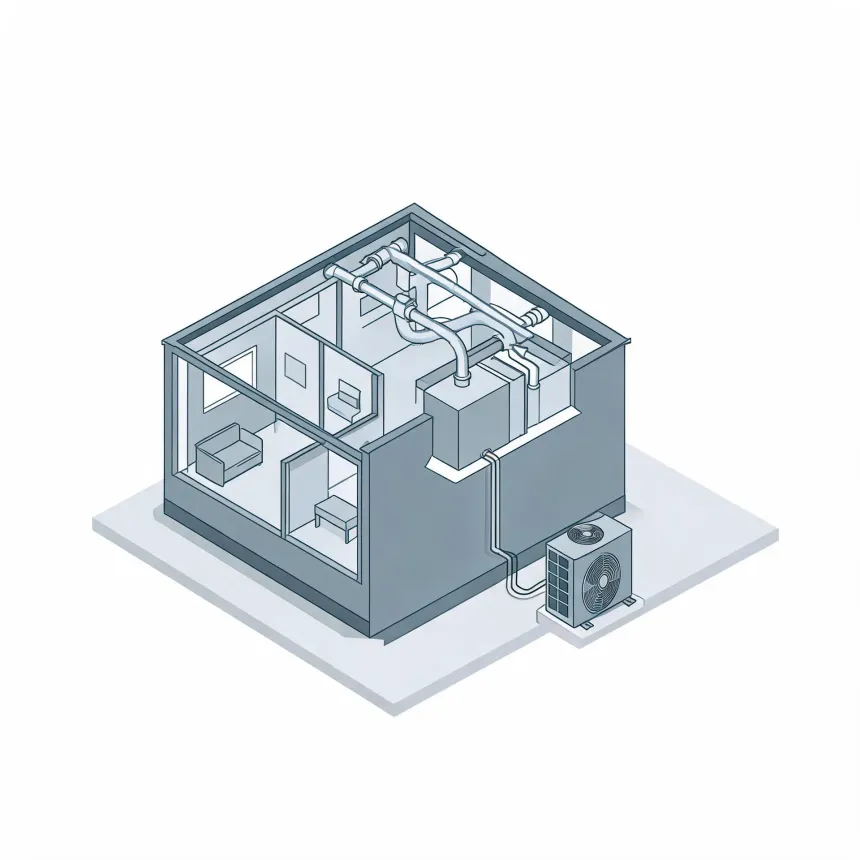
Isometric line illustration of a cutaway house showing interior rooms with furniture, ceiling ductwork connected to an indoor air handler, and refrigerant lines running to an outdoor condenser unit on a pad.
Your system heats September through June and cools July through July.

NOAA nClimDiv, 1991–2020 normals

Winter storms hit Blaine County 142 times between 2015 and 2024, more than any other weather event here.

A heat pump installed in Hailey needs to hold up to snow and ice loads every winter, which a standard unit is built for.

A heat pump sized right for Hailey holds up fine on its own

38 damaging wind events from 2015 to 2024
142 winter storms from 2015 to 2024
Winter nights average 14°F
A standard heat pump is the right call hereIdaho power runs 11.52 cents a kilowatt-hour, a standard size and efficiency covers this house

A heat pump has to be sized to the house, not picked off a chart by square footage alone. A contractor works out how much heat the house loses on the coldest day and how much heat it gains on the hottest one, then matches a system to that number. Too big and it short cycles, blasting on and off, never running long enough to pull moisture out of the air or settle into a steady temperature. Too small and it runs flat out without catching up, so the house never quite feels right and the system wears faster trying. The sizing also decides how the unit handles the point where it can't keep up alone and backup heat has to kick in. Get that number wrong and you feel it in every room, all season, not just on the hardest days.

Replace it before the season

Replace it before the season starts, so it happens on your schedule, not in a hurry.

Find a contractor
A gray outdoor HVAC unit mounted on a concrete pad beside a house with gray lap siding and a stone foundation.

The questions that matter aren't about size

Every heat pump is rated for how well it holds heat as the outdoor temperature drops, so ask where that rating stops doing the house any good and backup heat has to take over. Ask what that backup heat actually is, since some systems lean on electric strip heat that costs more to run, while others pair with a furnace that shares the ductwork. Ask how the system defrosts itself. Ice builds up on the outdoor coil in cold, damp weather, and the unit has to reverse itself to melt it off before it can keep heating. A good system does this without dumping cold air inside while it works. Ask about the compressor too. Some run at one speed, snapping on and off the way an old furnace does. Others modulate, easing up or down to match what the house needs in that hour, which tends to mean steadier temperatures and less wear from constant starts. None of this shows up on a spec sheet as a single number worth comparing. It shows up in how the house feels on the coldest morning of the year.

The old equipment gets hauled away

A contractor disconnects the old furnace, air conditioner or heat pump, recovers any refrigerant left in the lines, and removes the equipment from the property. Refrigerant can't legally be vented into the air, so it gets captured and taken off site along with the unit itself.

The ductwork usually stays

A heat pump can often run through the same ducts and vents the old system used, so there's rarely a need to tear out walls or ceilings to install one. The existing electrical panel and wiring get checked too, since a heat pump may draw differently than what was there before, and that gets sorted out as part of the install.

Installing a heat pump costs more up front than most other things touching the house, and a few things decide where a given job lands. Ductwork is one. If the existing ducts are the right size and in good shape, the crew connects to them and moves on. If they're leaky, undersized, or routed badly, bringing them up to shape takes real time, and time is most of what you're paying for. Electrical work is another. A heat pump pulls power differently than a straight furnace or AC did, and if the panel can't handle it, that's its own job before the heat pump goes in at all. Where the outdoor unit and refrigerant lines have to go, and how far that is from the indoor equipment, changes how much labor the install takes too. The equipment itself varies as well. A unit with a compressor that only runs at one speed costs less than one that modulates, and that difference shows up in the quote before anyone even talks about labor. None of this is padding. Each piece is either house-specific work that has to happen, or equipment built to perform differently, and both are worth asking about line by line.

Install day starts with the old system coming out, so expect the house without heat or cooling for a stretch while that happens. The crew sets the outdoor unit on a pad or bracket, runs new refrigerant lines if the old ones don't suit the new equipment, and connects the indoor air handler or coil to the existing ductwork. Lines get pressure tested before any refrigerant goes in, since a leak found after the fact means pulling things apart again. Once everything's connected, the system gets charged with refrigerant to the exact amount the equipment calls for, not by eye. The last part is commissioning, where airflow and refrigerant levels get checked against what the manufacturer specifies, and the thermostat gets set up and walked through. A job done right ends with the contractor running the system through a full cycle, heating and cooling both, before calling it finished.