Your furnace doesn't get a break here
Winter mornings in McCall average 13°F, and homes in Valley County run heat every month of the year. There's no season where the furnace just sits.
Takes about a minute. No obligation.
Winter mornings in McCall average 13°F, and homes in Valley County run heat every month of the year. There's no season where the furnace just sits.
A furnace running nearly year round puts more hours on its igniter, blower motor and other parts than one that only runs a few months. When something acts up, it's worth finding the actual cause instead of guessing.

NOAA nClimDiv, 1991–2020 normals
Electricity in Idaho ran $33.76 per million Btu in 2024.
A furnace that's short-cycling or running long burns through that cost every month it's heating your house.




If your furnace came with the house, repair is usually the better call before replacement even enters the conversation. A furnace that age still has working parts behind whatever's failing now, an igniter, a blower motor, a control board, and most of those can be fixed on their own. Replacement makes more sense when the whole unit is old enough that one failure is likely to be followed by another. Worth checking when your system went in, since that tells you which situation you're actually in.
A furnace running nearly every month of the year is burning that $33.76 per million Btu whether it's working right or not. A furnace short-cycling or running long just burns it faster. Get a tech out to find out which one yours is doing.
Find a contractorA furnace that runs this many hours a year shows wear in specific ways. The burner cycles on and off more times over a season, and every cycle is a strain point for the igniter. A hot surface igniter gets brittle with age and eventually cracks, so the furnace tries to light and fails. Listen for a longer delay before the burners catch, or clicking that doesn't end in a flame. Watch the flame itself too. It should be steady and mostly blue. Yellow or flickering flame means the burner isn't getting clean combustion, and that's not something to leave alone. A blower motor under heavy use will start announcing itself before it quits, usually with a squeal on startup or a rattle that wasn't there before. If the air coming out of the vents feels cooler than it used to, or the furnace runs longer to reach the same temperature, something in the heat exchanger or blower isn't pulling its weight anymore. None of these fix themselves with more runtime. They get worse.
An igniter or a flame sensor fails on its own. Swap the part and the furnace runs fine, with nothing to say about the rest of the unit. A cracked heat exchanger is different. The burner and blower have been running against that crack for a while, and it usually shows up alongside other wear, not by itself.
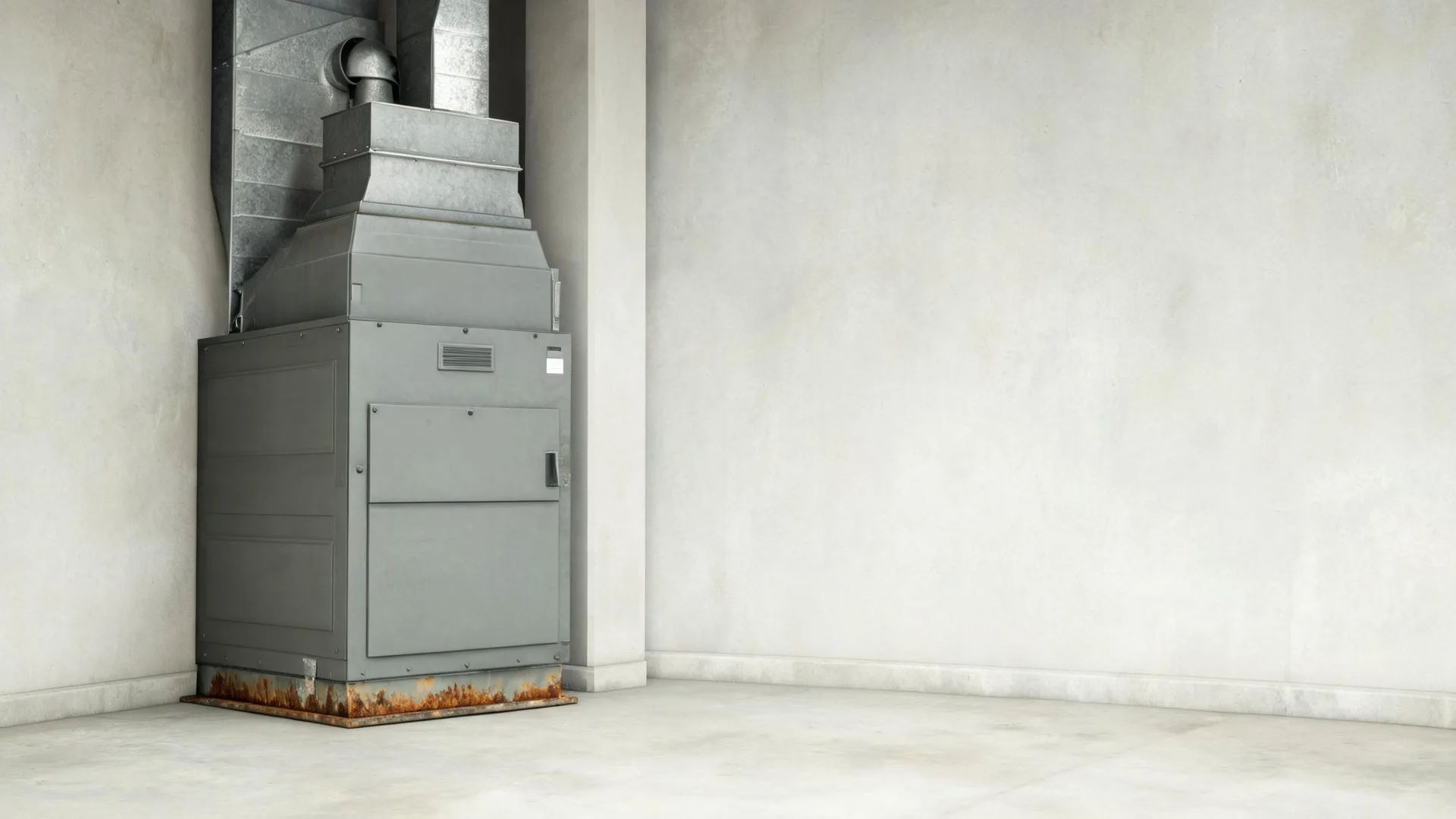
A tech opening up the furnace sees more than the one part that failed. Scorch marks, rust on the burner assembly, a blower wheel caked with dust that's been restricting airflow for years, these tell you how the rest of the furnace has held up. That's worth asking about, not just what broke.
A furnace that's struggling still tries to do its job, and that's the problem. A cracked heat exchanger keeps running. A clogged flame sensor lets the burner relight over and over instead of shutting down clean. Each extra cycle under a bad condition stresses the same parts that were already failing, the igniter, the blower bearings, the control board. A furnace that's short-cycling isn't resting between cycles, it's restarting the hardest part of the process again and again. Left alone, a small problem like a dirty flame sensor can carry enough heat and strain into the blower or exchanger that the repair grows well past where it started.
A diagnostic visit starts with watching the furnace actually run rather than guessing from what the owner describes. A tech turns it on and follows the sequence from ignition to flame to blower start to shutoff. Where that sequence hangs up points to the part at fault. A slow light off points to the igniter or gas valve. A short cycle points somewhere else entirely, maybe a flame sensor, maybe a limit switch. Airflow gets checked too, since a clogged filter or blocked duct can look like a failing blower motor when the motor itself is fine. A flame sensor and an igniter get pulled and looked at directly, because a coated sensor and a cracked igniter can cause the same symptom at the thermostat. The heat exchanger gets inspected last, since that's the finding that changes the conversation from repair to replacement.