Split firewood stacked against the dark vertical board siding of a house, beside a gravel strip, an outdoor air conditioning unit, dry grass and pine trees.

Furnace Repair in Arco, ID

Tell us about the job

Takes about a minute. No obligation.

RepairFurnace or heatingButte County, ID
Step 1 of 2

What ZIP code is the job in?

Ten months of work a year

Furnaces in Butte County run from September through June. That leaves only a couple of months where the furnace sits idle. The rest of the year it's cycling on and off to hold the house at temperature, putting more hours on the igniter, the blower motor, the gas valve than a furnace sees in most parts of the country.
What a storm asks of the furnace

Butte County saw 92 winter storms between 2015 and 2024, heavy snow, ice and blizzards. Each one means the furnace runs longer to keep up as cold air pushes into the house. A part already worn down from the long heating season is more likely to fail right when a storm hits and the furnace needs to work hardest.

10 months
September through June, your furnace is on duty
11°F
the average winter night it heats against
92 winter storms
in ten years, the nights a failure hurts most
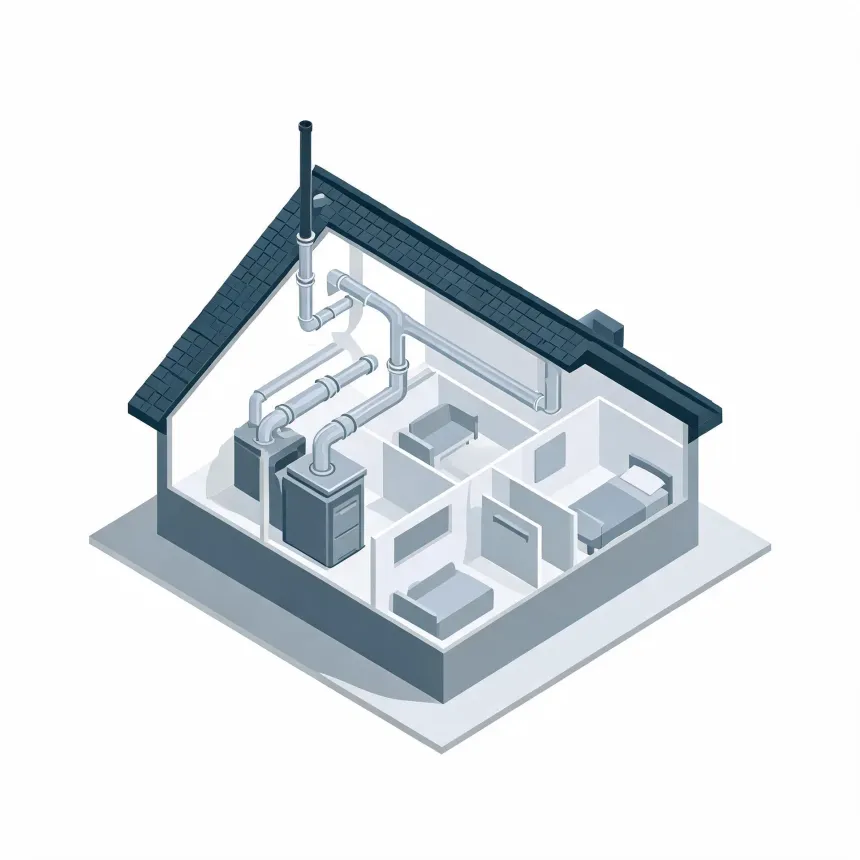
Isometric illustration of a cutaway house showing a furnace unit with ductwork and a flue pipe running through the interior rooms, which contain simple furniture.
Your furnace works hardest from November through April.

NOAA nClimDiv, 1991–2020 normals

Half the homes in Butte County were built in 1971 or earlier.

A furnace in one of those houses has had decades of hard winters to wear it down before this repair came up.

A furnace that keeps misfiring or short-cycling isn't just annoying, it's pulling power on every attempt whether the house gets warm or not. Here that adds up faster than it would somewhere with cheaper power or a shorter season. Waiting doesn't make the part fix itself, it just means more cycles spent working around whatever's already failing. Getting a contractor to find the actual cause now is what stops that from running up the bill all winter.

Get the real cause found before the next storm asks more of it

A furnace that's been cycling on and off for ten months doesn't fix itself over the summer. Whatever's making it short-cycle or run longer than it should is worth having a contractor look at and diagnose properly, so the repair holds through the next storm instead of just the next mild day.

Find a contractor
A man in a dark shirt and tan work pants, seen from behind, carries a canvas tool bag up wooden steps toward a blue front door of a gray clapboard house, with a shrub in a blue planter beside the door.
A gas furnace with attached ductwork, gas piping, and condensate lines installed in a concrete-block basement.

How old is the furnace itself

If the furnace came with the house and the house dates back to 1971 or earlier, it's had a long run already. Parts don't fail on a schedule, but an older unit gives a contractor less room to just patch the one thing that broke. Worth asking, before paying for the repair, how much life is left in the rest of it.

What the furnace is telling you

A furnace doesn't fail without warning signs first. It might short-cycle, running for a minute or two and shutting off before the house warms up. It might take several tries to light, clicking and then giving up. The blower might keep running after the burners shut off, or kick on with a bang instead of a smooth start. A flame that burns yellow instead of blue means something isn't burning clean. Any of these is the furnace telling you a part is already failing, not working the way it should.

What's worth a call now

A furnace that won't hold a thermostat setting, or that cycles more often than it used to, has a part working harder to make up for a problem underneath it. Left alone, a failing igniter or a dirty flame sensor doesn't get better, it gets to where the furnace won't light at all. A burning smell that doesn't fade after the first few minutes, or a furnace that trips its breaker, means stop running it and get a contractor to look before using it again.

Most furnace failures trace back to a handful of parts that wear with use, not age alone. The igniter takes a jolt of electricity every time the furnace starts, and over enough cycles the element gets brittle and breaks. The flame sensor sits in the burner flame and builds up a film of carbon over time, until it can't tell the furnace a flame is there and shuts the gas off as a safety measure. The blower motor has bearings that wear down after years of starting and stopping, which is often what's behind a grinding or squealing sound. A gas valve can stick or weaken so it doesn't open all the way, leaving the burners starved and the flame uneven. Filters matter more than people think, because a clogged one chokes airflow and makes every other part run hotter and harder than it should.

Most homes in Butte County heat with electricity, and Idaho power runs $33.76 per million Btu. That's a statewide figure, not a bill for this house, but it points at something worth knowing. A furnace that's short-cycling or struggling to light still pulls power for every attempt, even the ones that don't end up heating the house. This furnace runs most months of the year here, not just the coldest stretch, so a part working harder than it should adds up differently than it would somewhere milder. A furnace running the way it's supposed to is worth more than what the repair costs to get it there.