August is the month to do this
Heat goes on in September in Teton County and stays on through June. Scheduling a furnace installation in August gives an installer time to size the job right and finish before that first cold morning.
Takes about a minute. No obligation.
Heat goes on in September in Teton County and stays on through June. Scheduling a furnace installation in August gives an installer time to size the job right and finish before that first cold morning.
A furnace put in under pressure, with no time to check the sizing or look over the ductwork, is still the furnace running every morning from September through June. Doing this in August means it gets done right instead of fast.
NOAA nClimDiv, 1991–2020 normals
A furnace in Teton County runs about ten months a year, with overnight lows averaging 12°F in December, January and February.
A furnace sized for an easier climate will fall behind here, so this is a job worth sizing right the first time.



A furnace gets sized by a load calculation, not by matching whatever was there before. A contractor works out how fast the house loses heat on the coldest mornings, looking at square footage, window area, insulation, ceiling height, and how much outside wall the place has. That number tells them the output the new furnace actually needs. Too big and the furnace short cycles, heating the air fast then shutting off before it pulls the chill out of the floors and walls, which leaves rooms feeling uneven and wears out the parts faster. Too small and it runs flat out on the coldest nights and still can't keep up. The nameplate on the old unit isn't proof of anything, since it may have been wrong from the start or sized for a house that's since been added onto or insulated differently.
Replace it before the season starts, so it happens on your schedule, not in a hurry.
Find a contractorThe old furnace does not get a trial run or a slow handoff. Once the new one is in, the installer disconnects the gas line, the venting and the ductwork from the one being replaced, and it comes out. If it is a gas furnace, the gas line gets capped and the vent pipe or chimney liner it used is either removed or sealed off, since an open vent connection left behind is a hazard. The ducts get fitted to the new unit's supply and return. None of that old equipment stays behind as a backup. Whatever gets installed is what carries the house from the first cold morning on.
The efficiency rating on the label says how much of the fuel burned turns into heat in the house versus what goes out the vent. It has nothing to do with how much heat the furnace can put out or whether it's the right size for the house. A high-efficiency furnace that's undersized still won't keep up on the coldest mornings. The rating and the load calculation are separate questions, and both need answering.
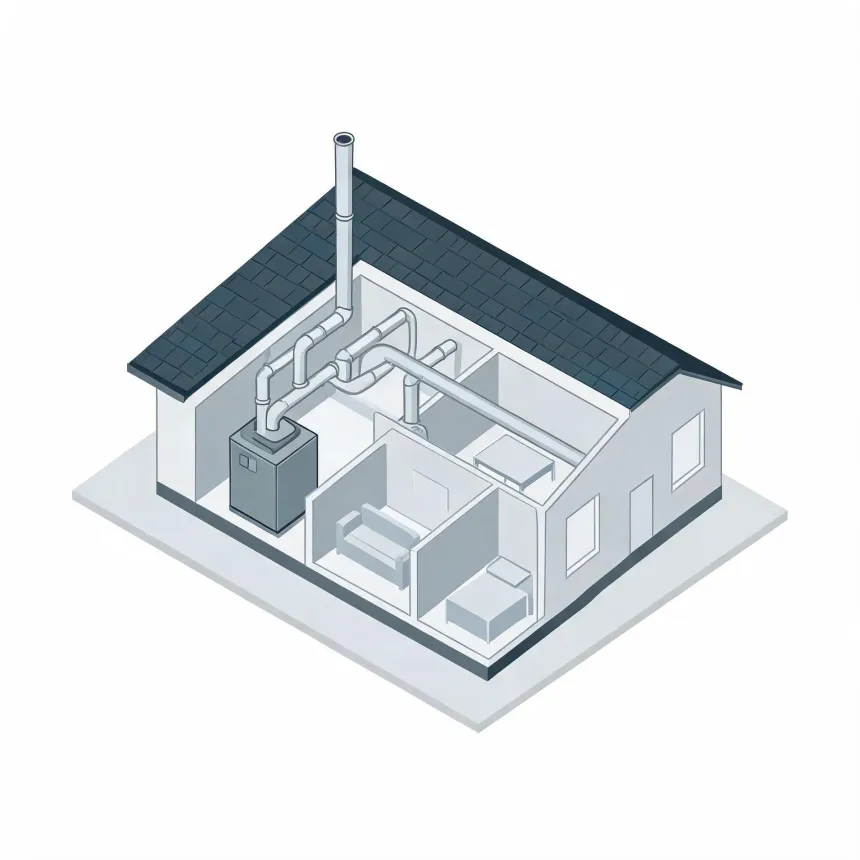
Furnaces with a higher efficiency rating pull more heat out of the exhaust before it leaves the house, so that exhaust comes out cool instead of hot. Cool exhaust can't rise up a chimney on its own, so those furnaces vent out through the side of the house with plastic pipe instead of up through a flue. That's a different installation, not just a different furnace, and it's worth asking the installer about before deciding which rating fits the house.
The furnace itself is only part of what gets paid for. Venting work takes real labor, especially when the new furnace exhausts differently than the old one did. Ductwork matters too. If the existing ducts are undersized or leaky, bringing them up to a size that can carry the new furnace's output adds to the job. The gas line and electrical hookup need to meet current code even if the old ones didn't, and that takes time to check and correct. A high-efficiency furnace also needs a condensate line to drain the moisture it pulls out of the exhaust. Permit and inspection work is part of the job as well. None of this is extra. It's what separates a furnace that's installed from one that's just set in place and hooked up.
Installation day is longer than most people expect, and most of that time isn't spent on the furnace itself. The old unit comes out first, then the installer works through the gas line, the venting, the ductwork connections and the electrical hookup one at a time, checking each against code before moving to the next. Setting the new furnace in place and running it for the first time usually happens well into the day, not at the start. Once it's running, the installer checks the gas pressure, the temperature rise across the furnace and the airflow at the registers, because a furnace can be hooked up correctly and still need these adjusted to run the way it's supposed to. Expect some noise and some mess, mainly where venting or ductwork is being cut and fitted. A straightforward swap with no surprises in the ductwork or venting still takes most of a day done right.