A single-story black board-and-batten house with a dark standing-seam metal roof, timber entry porch posts on stone bases, set among tall pine trees with dry grass in the foreground under an overcast sky.

Heat Pump Repair in Twin Falls, ID

Tell us about the job

Takes about a minute. No obligation.

RepairHeat PumpTwin Falls County, ID
Step 1 of 2

What ZIP code is the job in?

Winters here are cold, not harsh on the system

Overnight lows average 21°F through December, January and February. A heat pump works harder below freezing, but that's a steady, predictable cold, not the kind of extreme swing that wears equipment down fast.


A broken heat pump is usually worth fixing

Without constant strain, parts tend to fail from age or a specific issue rather than being run down. If yours is acting up, there's a good chance the fix is a single part doing the damage, not a system near the end of its life.

9 months
September through May, your system heats
2 months
July through August, it cools
21°F
the average winter night it heats against
83°F
the average summer afternoon it cools against
Isometric cutaway illustration of a single-story house showing interior rooms, attic ductwork and an air handler, with an outdoor condenser unit connected by lines along the exterior wall.
Your system heats September through May and cools July through August.

NOAA nClimDiv, 1991–2020 normals

Half the homes in Twin Falls County were built in 1982 or later.

If your heat pump came with a newer house, it's probably not old enough to be the reason it's acting up.

August and September are when a weak part finally gives out

Cooling runs July through August
Heat runs September through May
28 damaging wind events from 2015 to 2024

It's usually worth repairing

It has an easier job here than in most places, so your heat pump is often in decent shape. Repair is usually worth it.

Find a contractor
A man in a cap, gray long-sleeve shirt and tan work pants carries a canvas tool bag up gray porch steps toward a dark blue front door, with a blue ceramic planter and shrub beside it.
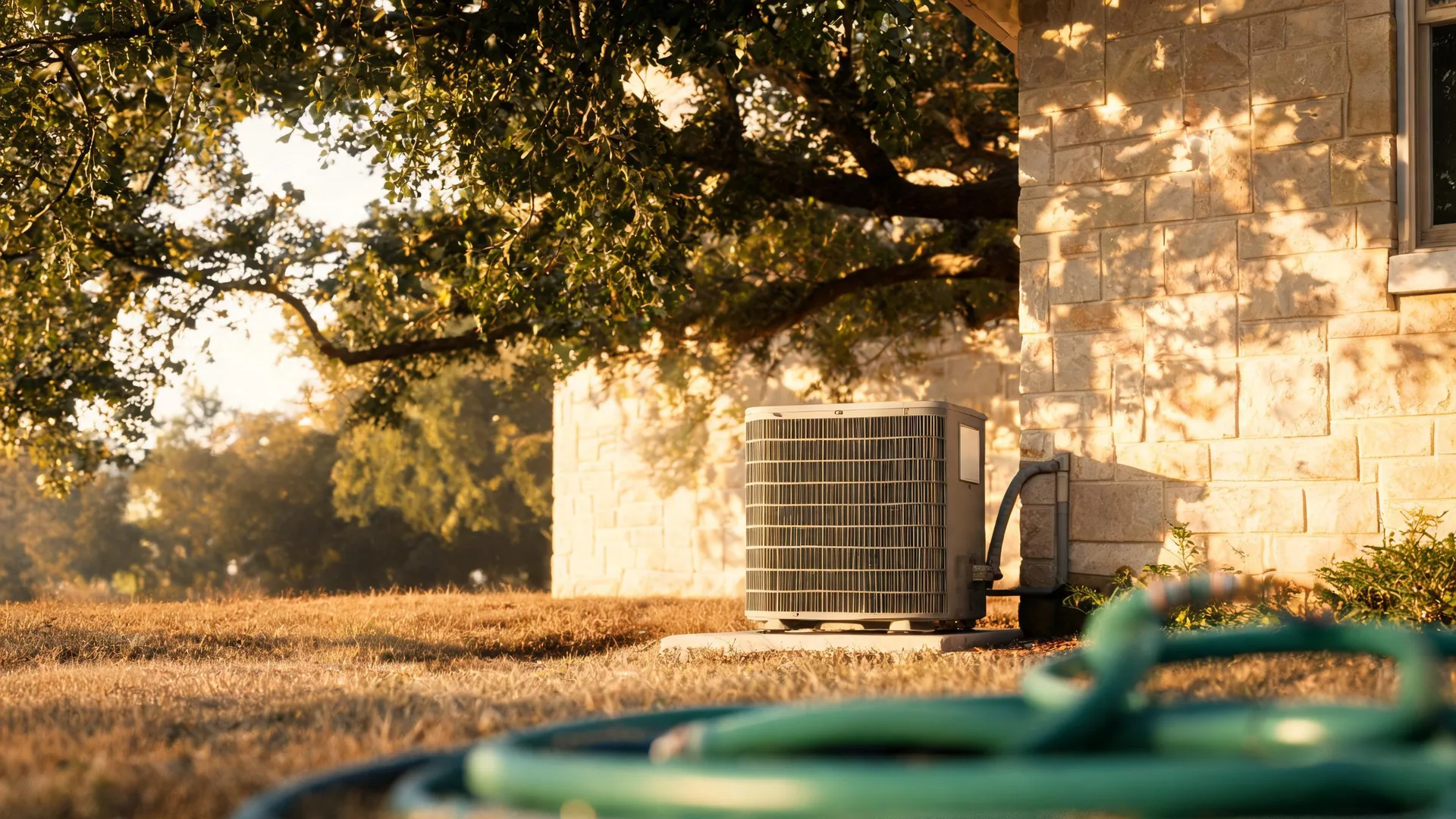
A dark gray heat pump unit mounted on a concrete pad next to a house with gray siding and a stone veneer wall.

A small problem left running becomes a bigger one

A part that's struggling usually sends a warning before it quits outright. A reversing valve that's starting to stick, a capacitor losing its charge, a coil losing its ability to shed heat, all of these show symptoms before failure. The trouble is the system doesn't stop and wait for a repair. It keeps cycling, keeps switching between heat and cool, and every cycle puts the same strain on the part that's already struggling. A weak capacitor forces the compressor to draw harder on startup, every single time it starts. A reversing valve that's not fully seating makes the system work against itself, heating and cooling at once, until something gives. Ice that isn't clearing off the coil blocks airflow more each cycle, and the compressor behind it works harder to compensate. None of these fix themselves by running longer. The part either gets replaced while it's a simple swap, or it keeps absorbing damage until it takes the compressor down with it.

Check the thermostat first

Make sure it's set to heat and the set temperature is actually above room temperature. Check the batteries if it uses them. Low batteries can cause the display to look normal while the system doesn't respond underneath it.

Look at the outdoor unit

Walk outside and check the outdoor coil for ice buildup or a pile of leaves and debris pressed against it. Clear away anything blocking airflow. If the coil is caked in ice beyond a thin frost, that's a sign for a contractor to look at, not something to chip off yourself.

Most calls start with the system not keeping up. It runs, but the air coming out feels barely warm, or the house slowly loses ground even though the unit never shuts off. That points to the reversing valve not fully seating, or a refrigerant charge that has dropped. Short cycling is another one worth paying attention to, where the system kicks on, runs a couple minutes, and quits, over and over. That wears the compressor fast if it goes on too long. Ice on the outdoor coil that does not melt off between cycles usually means the defrost cycle has stopped working. A grinding or squealing sound from the outdoor unit is almost always the fan motor or a bearing, and it does not get better on its own.

When a repair is worth doing usually comes down to what actually broke. A failed capacitor, a bad contactor, a stuck reversing valve, these are single parts doing a single job. Replacing one does not shorten the life of everything else in the system. The compressor is the exception. It is the most expensive part to replace and the hardest to judge from outside, so a compressor failure is the one case where a contractor needs to look at the whole system before you spend money on it. Age matters less than people think. A system that has been maintained, filters changed, coils kept clean, tends to keep failing one part at a time rather than all at once. The question worth asking is whether this part failed on its own or whether it is a symptom of the compressor straining. One is a repair. The other needs a harder look.