







Illuminated timber-and-stone luxury homes photographed at twilight with snow-capped mountains visible in the background.

Heat Pump Repair in Rupert, ID

Tell us about the job

Takes about a minute. No obligation.

RepairHeat PumpMinidoka County, ID
Step 1 of 2

What ZIP code is the job in?

Nine months of heat, September through May, then two months of cooling in July and August. That long heating stretch is why most repair calls here land in the first cold snap of fall, right after the system switches over. A part that was already weak gets asked to carry full load for the first time, and that is when it quits. August is the last easy month to catch it before that switch happens. If yours ran rough last winter, the same fault is probably still sitting in there.

9 months
September through May, your system heats
2 months
July through August, it cools
18°F
the average winter night it heats against
84°F
the average summer afternoon it cools against
Isometric cutaway illustration of a single-story house showing interior ductwork, an indoor air handler and furnace unit, and an outdoor condenser connected by a line, on a white background.
Your system heats September through May and cools July through August.

NOAA nClimDiv, 1991–2020 normals

Rupert winters average 18°F at night, and that's the hardest work a heat pump does here.

No hurricanes, no heavy humidity load, just cold air to pull heat from, so a unit that's been maintained usually has the parts left to fix.

Nothing about Rupert wears out a heat pump faster. It's the usual part, and it's usually fixable.

Power costs 11.52 cents a kWh statewide
42 damaging wind events from 2015 to 2024
7 hail events from 2015 to 2024
Nothing unusual here, just a part that wore outHalf the homes in Minidoka County were built in 1976 or earlier, half later. Either way, the fix is the same.

Before you call, check the thermostat is set to heat and the batteries aren't dying. Walk outside and look at the outdoor unit. If it's packed in ice or snow, or leaves and debris have blocked the sides, clear it by hand and give it a few minutes to respond. Check the breaker it runs on, since a tripped breaker will stop it cold with no other sign. Look at the vents inside and make sure none are closed or blocked by furniture. If the filter looks gray or packed with dust, swap it, because a choked filter makes the whole system work harder and can trigger a shutoff on its own. If you hear the outdoor unit running but no warm air is coming from the vents, or it's blowing cold instead of warm, that's past what you can fix by hand.

Get it looked at early

Problems tend to show up in the first weeks of the season, when the load hits a part that was already weak.

Find a contractor
A man in a dark jacket and tan pants, seen from behind, carries a canvas tool bag up concrete steps toward a blue front door of a house with light horizontal siding and a potted shrub in a blue planter.
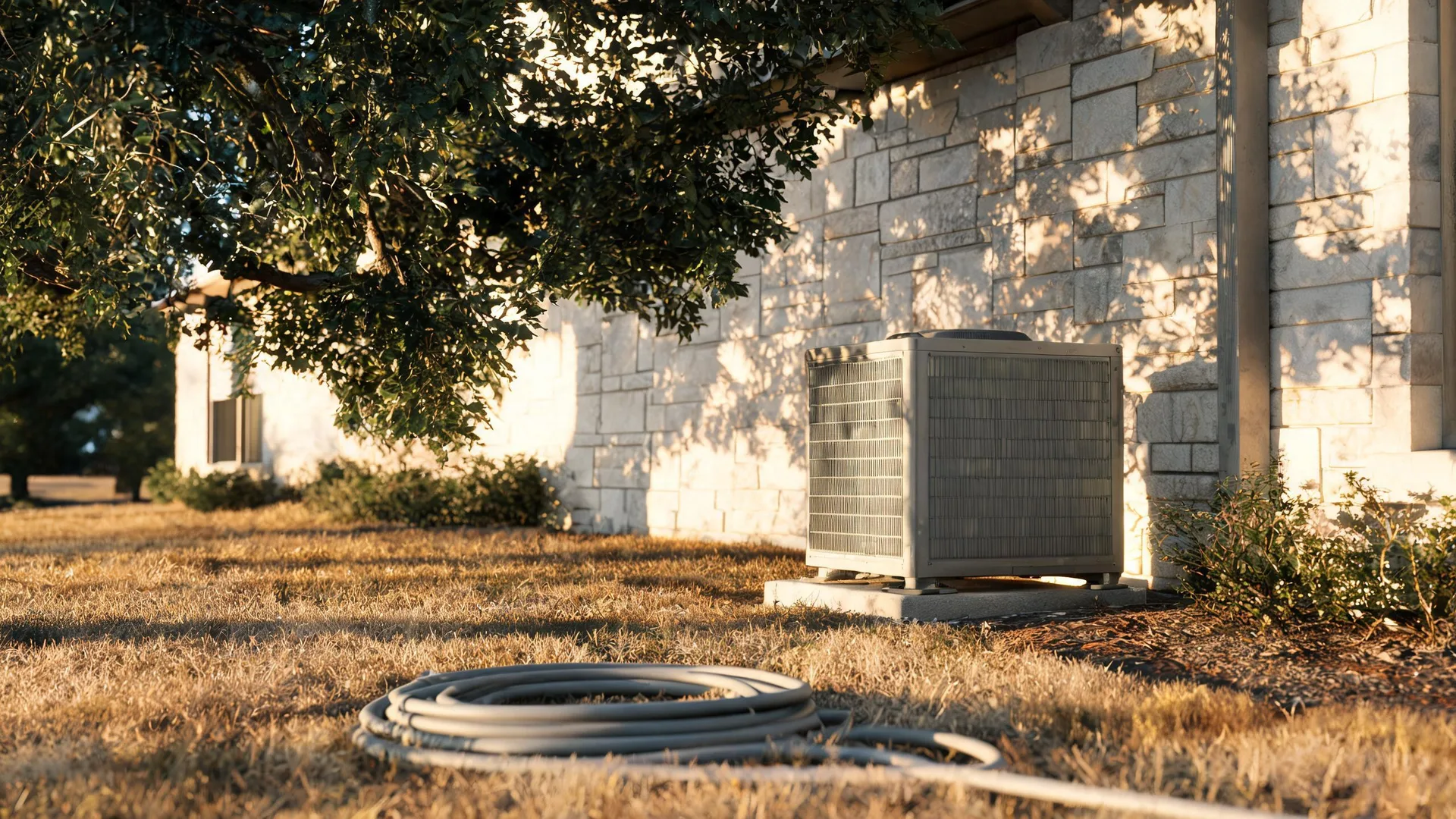
A gray heat pump outdoor unit mounted on a concrete pad next to a residential house with lap siding and stone accents.

What a diagnostic visit actually finds

A diagnostic call starts outside, at the unit itself. The tech checks the readings on the refrigerant lines, the amp draw on the compressor and fan motors, and the voltage going to the board, before anything gets taken apart. That tells them which part of the system is carrying the problem, the electrical side, the refrigerant side, or airflow. Inside, they pull the panel and look at the capacitor, the contactor, and the defrost board, checking each against what it should read, not just whether it looks fine. If the outdoor coil was icing, they watch a defrost cycle run to see if it actually clears or if the board never triggers it. Only once the bad part is confirmed does the conversation turn to fixing it.

What shows up before a breakdown

Warm air turns lukewarm before the system ever quits outright. It runs longer to hold the same temperature, cycles on and off more than it used to, or the air at the vent feels closer to room temperature than heat. Some homeowners notice frost on the outdoor unit that stays put even after a defrost cycle should have cleared it. A hissing or gurgling sound at the lines points to refrigerant, not something to wait out.
Noise and smell tell you where to look

A grinding or screeching from the outdoor unit usually means a motor bearing is going. A burning smell from the vents is the one sign that means shut it off and call rather than wait. A reversing valve stuck in one position will leave you with air that never switches from cool to warm, which is easy to mistake for a thermostat problem but isn't.

Most heat pump failures trace back to a handful of parts, and they fail for ordinary reasons. The capacitor that kicks the compressor and fan motors into motion weakens with every start it gives, so after enough seasons it stops delivering the jolt they need and the outdoor unit hums without starting. Contactors pit and burn from the arcing every cycle produces until they stop making clean contact. Refrigerant charge doesn't get used up, so a system low on charge has a leak somewhere in the lines or coil, and that leak only gets worse left alone. The defrost board can fail and leave the outdoor coil icing over with no way to clear itself. Motor bearings wear down from years of spinning until they bind or seize. None of these are tied to one bad day of weather. They're wear that's been building for a while, and the first real cold snap is just when a part finally gets asked for more than it has left to give.

Whether a repair makes sense comes down to what broke and what it's connected to. A capacitor, a contactor, a defrost board, these are self-contained parts. One fails, it gets swapped, the rest of the system doesn't know the difference. The compressor is a different animal. It's the most expensive part in the unit, and when it fails the question becomes whether a unit old enough to lose a compressor is worth putting a new one into, since everything else on it has logged the same years. A refrigerant leak sits in between. Patch the leak and recharge it, and it holds, unless the leak is in the coil itself, in which case it's going to find a new spot to let go. Ask what failed before asking what it costs. That tells you which kind of repair you're actually looking at.