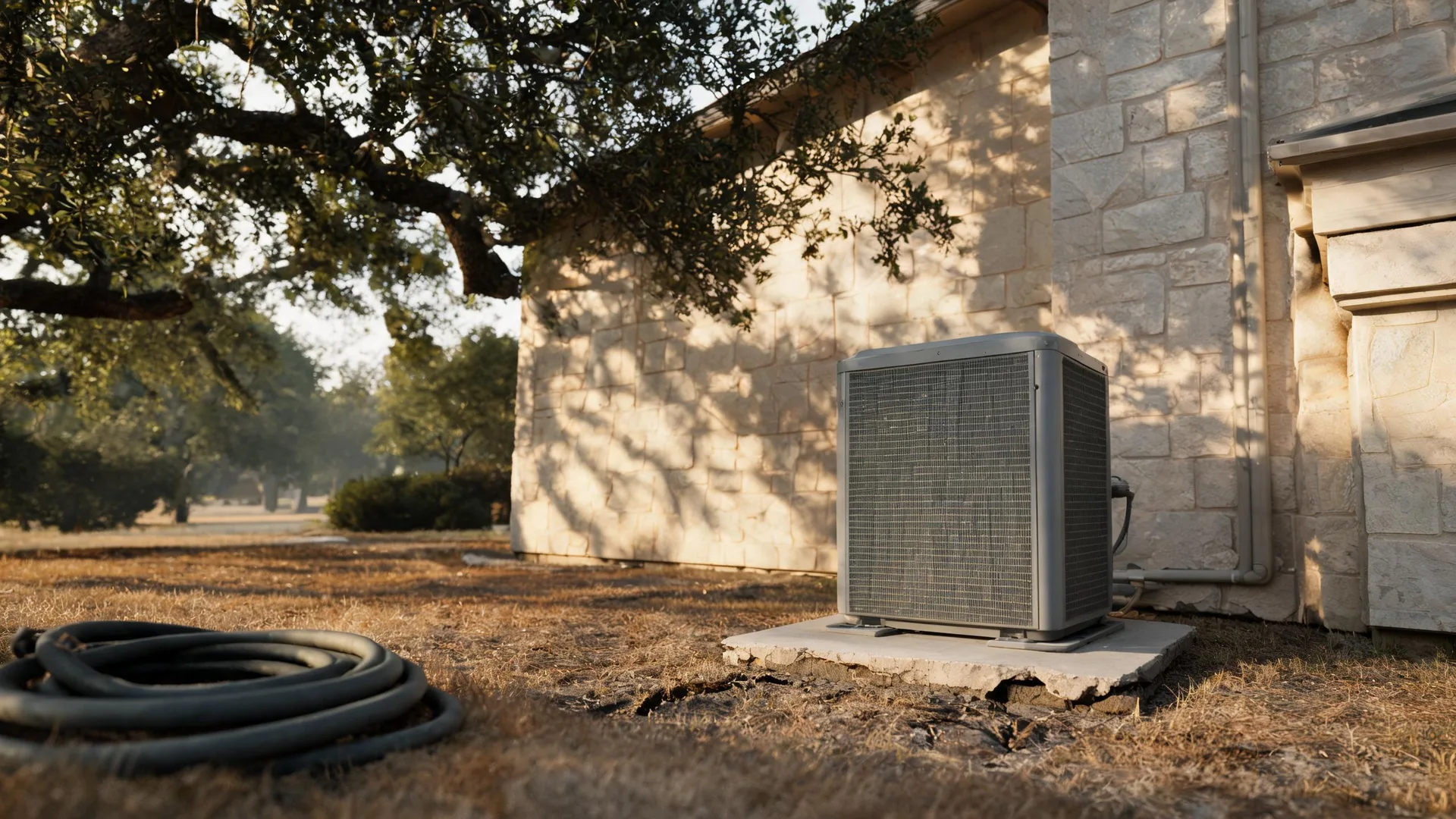
August is when weak units fail
Heat here switches over in September, which makes August the month a heat pump gets tested hardest. A unit that was already struggling tends to quit right when it has to carry full heat for the first time.
Takes about a minute. No obligation.
Heat here switches over in September, which makes August the month a heat pump gets tested hardest. A unit that was already struggling tends to quit right when it has to carry full heat for the first time.
A heat pump limping along in cooling mode can still seem fine in July. Once it has to reverse and produce heat, the same weak part often can't keep up. Catching it before September means a repair instead of a no-heat call.

NOAA nClimDiv, 1991–2020 normals
A tech starts a heat pump diagnostic by running the unit in both heat and cooling, not just the mode that's failing.
Testing both modes catches a bad reversing valve, a problem that can hide if only the failing side gets checked.




If your heat pump came with the house, parts for it are usually easy to get and a tech has likely seen that exact model before. That's worth something when you're deciding whether to fix it or replace it. A newer unit with one bad part, a failed capacitor or a stuck reversing valve, is a repair, not a reason to start over. Get it diagnosed before you assume the worst.
Problems tend to show up in the first weeks of the season, when the load hits a part that was already weak.
Find a contractorA heat pump fails the same handful of ways. The reversing valve sticks, so the unit keeps blowing cold air when it should be heating, or it gets stuck heating when it should cool. The run capacitor weakens over years of starting the compressor and the fan motor, and once it drops too far neither one starts right. The defrost board misreads the coil temperature and either skips defrost cycles, so the outdoor coil ices over solid, or runs defrost too often and the unit can't keep up with the heat load. Low refrigerant charge from a slow leak shows up as a unit that runs constantly but never quite gets there. None of these happen because a heat pump works hard. They happen because a part wears down and the next heavy call on the system is the one it can't answer.
A clogged filter starves the system of airflow, and a heat pump short on airflow can ice up or struggle to hit temperature. Pull it out and look at it. If you can't see light through it, that alone could be the whole problem.
Walk outside and check the outdoor coil for a heavy buildup of ice or frost beyond a normal thin layer. Clear away leaves, snow or anything blocking the sides and top. A unit that can't breathe outside will act like it's broken inside.
Short cycling is one of the clearer signs something's wrong. A heat pump that turns on, runs for a couple minutes, then shuts off, then starts again, isn't resting between cycles the way it should. That pattern wears on the compressor and usually points to a refrigerant problem, a bad sensor, or an electrical fault telling it to stop before it's actually satisfied. Warm air coming out of the vents in heat mode is another one, since a working heat pump should feel warm at the register, not lukewarm or barely above room temperature. And a unit that runs nonstop without ever shutting off is struggling just as much as one that won't stay on, it just fails in the other direction.
Age by itself doesn't tell you whether to fix a heat pump or replace it. What matters more is how many parts have already failed and whether the compressor itself is still sound. A unit that's needed a new capacitor once and now needs a sensor is still a normal repair history. A unit where the compressor is starting to go is a different conversation, since that part isn't cheap to replace on its own and a tech will usually tell you straight if it's worth doing. Ask what's failing and why, not just how old the system is. A heat pump that's been maintained and is only now seeing its first real failure almost always gets fixed.