





A gray outdoor HVAC condenser unit mounted on a concrete pad in the front yard of a two-story suburban house.

Heat Pump Repair in Burley, ID

Tell us about the job

Takes about a minute. No obligation.

RepairHeat PumpCassia County, ID
Step 1 of 2

What ZIP code is the job in?

Heat pumps in Burley work close to ten months a year, covering heat from September through June and cooling in July and August. August is the month to get a heat pump looked at, right before it has to switch over and carry the load of a Cassia County winter. A part that was already weak, a worn contactor or a low charge, tends to give out right when the system shifts into heating and has to work harder. Catching it in August, before the first cold week hits, means a repair instead of a no-heat call in September.

10 months
September through June, your system heats
2 months
July through August, it cools
20°F
the average winter night it heats against
81°F
the average summer afternoon it cools against
Isometric line illustration of a cutaway single-story house showing interior rooms with furniture and ceiling ductwork, connected to an outdoor condenser unit on the ground outside the left wall.
Your system heats September through June and cools July through August.

NOAA nClimDiv, 1991–2020 normals

Cassia County winters hold a 20°F average overnight low, not an extreme cold load.

A heat pump here is rarely worn out from the work. If it's failing, something specific failed.

Wind and hail here are ordinary, and so is electricity

Power costs 11.52 cents a kWh statewide
85 damaging wind events from 2015 to 2024
9 hail events from 2015 to 2024

Half the homes in Cassia County were built in 1975 or earlier, half in 1975 or later. A heat pump does not care which. What matters is whether the system in the house now is the one it came with, or something added later, and whether the ductwork was sized for it. That is worth checking before a repair call, not because the house is old or new, but because it tells the contractor what they are walking into. A heat pump fails the same ways in an older house as in a newer one, from the same worn parts. Nothing about the age of the house changes the diagnosis.

Find what failed, then fix it

A heat pump that's giving out here usually has one part that failed, not a system worn down by the work. Find that part and fixing it makes sense.

Find a contractor
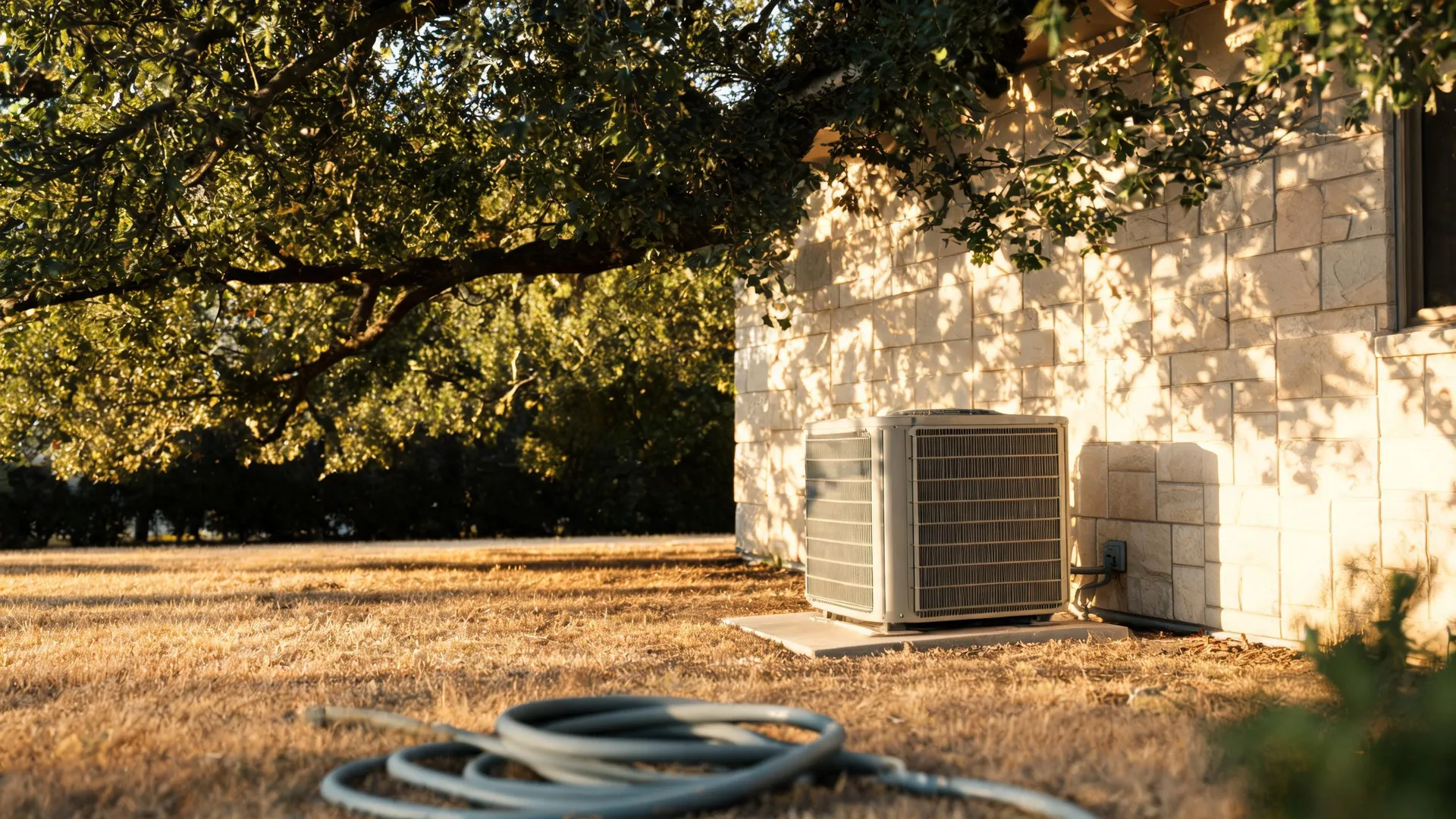
A gray heat pump condenser unit mounted on a concrete pad against the gray lap-siding exterior wall of a house.

One part gives out, not the whole system

A heat pump fails one part at a time. The reversing valve sticks and the system gets stuck in one mode, blowing cold air when it should be heating. The defrost control stops sensing ice on the outdoor coil, so frost builds up until the unit can't pull heat from the air at all. A contactor pits and burns from years of opening and closing, until one day it doesn't close. Refrigerant leaks slowly from a chafed line or a bad fitting, and the system runs longer and longer to make the same heat before it quits making any. None of these are the compressor wearing out. The compressor is usually the last thing to go, and in most failures it never fails at all. Something smaller gave out first and took the system down with it.

What you'll notice first

A heat pump in trouble shows up in what it stops doing right. Air blowing from the vents that feels cool instead of warm, even though the thermostat calls for heat. Ice on the outdoor unit that doesn't clear on its own. Short cycling, where the system kicks on and off every few minutes instead of running a normal stretch. A hissing sound near the lines. Each of these points to one failed part, not a unit on its way out.
What waiting does to the system

A heat pump that's struggling keeps running anyway, just worse. A low refrigerant charge makes the compressor work harder to move less heat, and that extra strain is what eventually takes the compressor down with it. A reversing valve stuck in the wrong mode means no heat at all until it's replaced. None of these parts fix themselves, and the system doesn't rest and recover on its own.

A few things are worth checking before you call anyone out. Go to the thermostat and make sure it's set to heat, not auto or cool, and that the fan is set to auto, not on. Check the breaker box for a tripped breaker on the heat pump's circuit, and check the outdoor unit for anything blocking it, leaves, a cover, a drift of snow against the side. Look at the air filter. A filter clogged with dust and pet hair chokes off airflow and can make a heat pump run constantly without ever catching up. If the outdoor unit is caked in ice past what normally melts off in a defrost cycle, that's worth noting but not worth chipping at yourself. None of this will fix a stuck reversing valve or a low charge, but it rules out the simple stuff first.

A diagnostic visit starts outside, at the unit itself, before anything gets opened up. A contractor will check the pressures on the refrigerant lines, because that number says more about a heat pump's health than almost anything else. They'll run the system in both modes, heat and cool, to see whether the reversing valve actually switches when it's told to. They'll pull the access panel and look at the contactor and capacitor, since both wear out from ordinary use and both are easy to check once the cover's off. A clamp meter on the compressor's wiring shows whether it's pulling the right amount of power or straining to do its job. None of this takes guesswork. Each test points to a part that's either working or isn't, and that's what tells a contractor whether the fix is a quick swap or something bigger.