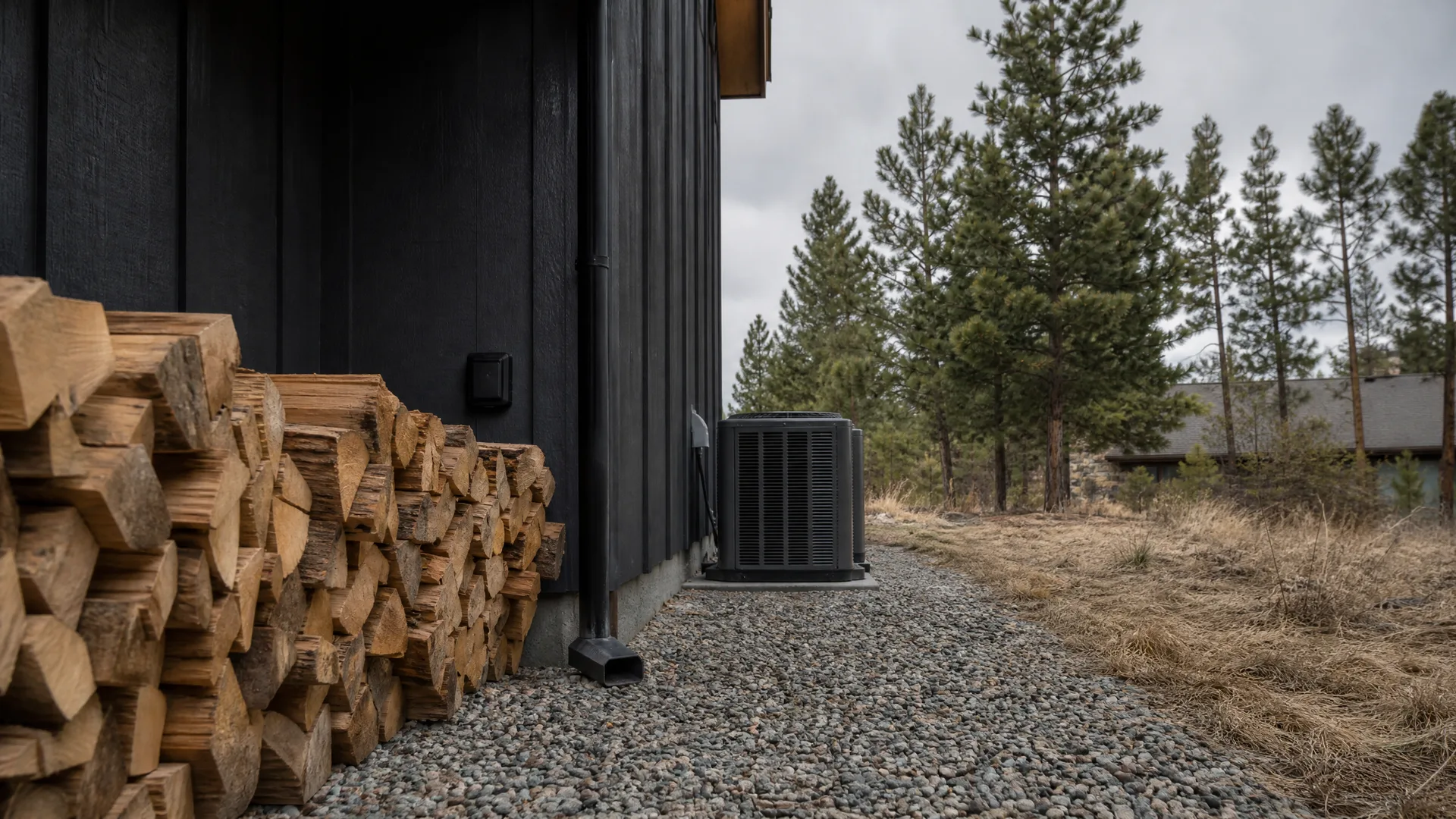






A stack of split firewood beside a dark vertical-board house wall, with an outdoor air conditioning condenser unit on a gravel path and pine trees under an overcast sky.

Heat Pump Repair in Boise City, ID

Tell us about the job

Takes about a minute. No obligation.

RepairHeat PumpAda County, ID
Step 1 of 2

What ZIP code is the job in?

A heat pump in Ada County isn't fighting extreme heat most of the year, and winter lows here average 25°F, which is cold but not brutal on the system. The wear on a heat pump comes from how hard it has to work, and this one doesn't have to work as hard as units in harsher climates. That usually means when something goes wrong, it's a part failing from age or lack of maintenance, not a system that's been run into the ground. A heat pump showing problems after years of this kind of moderate duty is often still a good candidate for repair rather than replacement.

8 months
October through May, your system heats
3 months
June through August, it cools
25°F
the average winter night it heats against
88°F
the average summer afternoon it cools against
Isometric line illustration of a cutaway single-story house showing interior rooms, ceiling ductwork connected to an indoor air handler, and refrigerant lines running to an outdoor condenser unit on a pad.
Your system heats October through May and cools June through August.

NOAA nClimDiv, 1991–2020 normals

Half the homes in Ada County were built in 1997 or later.

A heat pump that came with a newer house still has years in it worth repairing.

September and May are when a weak part gets found

Cooling runs June through August
Heat runs October through May
41 damaging wind events from 2015 to 2024

Get a repair looked at before winter, not during it. Ada County sees winter storms most years, and that's when a heat pump earns its keep, running long hours to hold the house at temperature against a 25°F night. A part that's already weak won't wait for a convenient time to fail. If your heat pump has been short-cycling or running constantly, have it checked now while a contractor can get to it on a normal schedule, not after the next storm hits and everyone else's is down too.

Fix it. The system underneath likely has years left.

If your heat pump came with the house, get the repair instead of pricing a new system. A unit built into a newer home still has years of working life in it, and a failing part doesn't change that.

Find a contractor
A man in a cap, work jacket and tan trousers carries a canvas tool bag up wooden porch steps toward a blue front door of a house with lap siding.
A gray heat pump condenser unit mounted on a concrete pad against the gray lap-siding exterior wall of a house.

The wear shows up as a symptom, not a shutdown

A heat pump runs in both directions, so it wears differently than a furnace or an AC that only works part of the year. Watch for ice building up on the outdoor unit that doesn't clear during the defrost cycle, air coming out of the vents that doesn't feel warm even though the system is running, or the unit switching between heating and cooling on its own. Short cycling, where it kicks on and off in quick bursts instead of running a full cycle, points to a failing sensor or a thermostat that's lost communication with the outdoor unit. A reversing valve that's sticking will often make the system blow cold air during a heating cycle, which gets mistaken for a refrigerant problem when it isn't. Any grinding or clicking from the outdoor unit that wasn't there before means a motor bearing or a contactor is wearing out. None of these mean the whole system is done. They mean one part is failing, and the rest of the unit is still doing its job.

The visit starts outside at the unit

A tech checks refrigerant pressure, looks at the condition of the outdoor coil, and watches how the compressor behaves on startup. Most of what a heat pump tells you about itself shows up here first, before anything gets opened up or tested with a meter.

Then it moves to what the thermostat can't see

Electrical testing comes next. The capacitor, the contactor, the reversing valve solenoid all fail in ways a homeowner can't spot from the symptoms alone. A system stuck in cooling mode and a system with a weak capacitor can look the same from inside the house, so the testing is what tells them apart.

Before calling anyone, check the thermostat batteries and make sure it's set to heat and a few degrees above room temperature. Go outside and look at the unit. If it's caked in ice beyond the thin frost that clears on its own during a normal defrost cycle, that's worth noting but don't chip it off yourself. Check that nothing is blocking airflow around the outdoor unit, no leaves, no snow piled against it. Inside, pull the air filter and hold it up to a light. If you can't see through it, replace it, since a clogged filter can cause a lot of the symptoms that look like bigger problems. Check your breaker panel for a tripped breaker before assuming a part has failed. None of this fixes a bad reversing valve or a weak capacitor, but it rules out the simple stuff first.

Repair versus replacement comes down to what actually failed, not how old the unit looks. A compressor is the one part that usually ends the conversation, since replacing it costs close to a new system and a compressor that failed once often points to a problem elsewhere that will just kill the next one too. Everything else, the capacitor, the contactor, the reversing valve, the fan motor, is a normal wear part that gets swapped on its own without touching the rest of the system. A unit that's been maintained, with clean coils and a filter that's been changed, tends to fail one part at a time, which is a good sign, not a bad one. The ones that end up getting replaced wholesale are usually the ones where neglect let a small problem run long enough to damage something bigger around it.