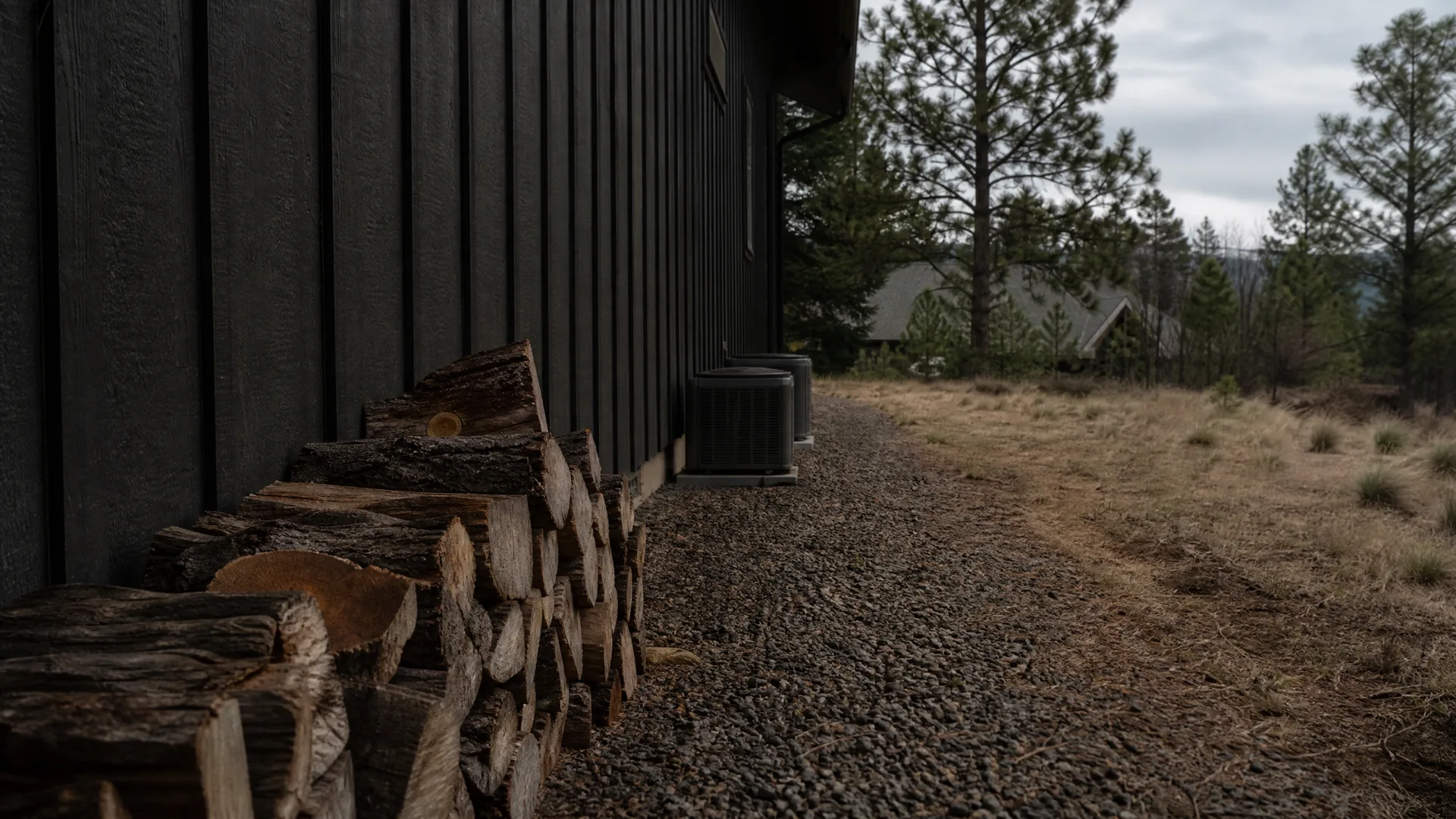




Stacked firewood along the dark vertical-board exterior wall of a house, with two outdoor condenser units, a gravel path, dry grass and pine trees under an overcast sky.

Heat Pump Installation in Payette, ID

Tell us about the job

Takes about a minute. No obligation.

New system or replacementHeat PumpPayette County, ID
Step 1 of 2

What ZIP code is the job in?

Electricity heats 44.3% of homes in Payette County, more than any other fuel, with utility gas close behind at 38.2%. That electric share matters if you're adding a heat pump, since the wiring and panel capacity a lot of these homes already have was sized for electric heat to begin with. A home that's run electric baseboards or an electric furnace may already have what a heat pump needs to run, where a gas-heated home might need an electrician to look at the panel first. Either way, a heat pump can replace what's there now or work alongside a gas furnace for backup on the coldest days.

8 months
October through May, your system heats
3 months
June through August, it cools
25°F
the average winter night it heats against
88°F
the average summer afternoon it cools against
Isometric illustration of a cutaway house showing interior rooms, ceiling ductwork and an air handler, connected by lines to an outdoor condenser unit on a pad beside the building.
Your system heats October through May and cools June through August.

NOAA nClimDiv, 1991–2020 normals

Payette County winters average 25°F at night, and heat pumps have to work harder to pull warmth from cold air.

A heat pump sized right for that overnight low will keep up without running flat out all season.

Heat runs eight months here, so get the heat pump in before September

Cooling runs June through August
Heat runs October through May
Climate zone 5B
Cheap power changes the mathIdaho electricity ran 11.52 cents per kilowatt-hour in 2024, so payback matters less than fit.

Payette County sits in climate zone 5B, a cool, dry zone where heating does more of the work than cooling. Any split-system heat pump installed here has to meet federal minimums of 14.3 SEER2 for cooling and 7.5 HSPF2 for heating. Those minimums apply to equipment made from 2023 on, so an older unit priced to move may not clear the bar. A heat pump meeting those numbers may also qualify for the federal tax credit, worth checking against the paperwork before you settle on a model.

A standard heat pump fits most homes in Payette County

Half the homes in Payette County were built in 1978 or earlier, half in 1978 or later. That spread doesn't point toward anything unusual in sizing. A standard-size, standard-efficiency heat pump fits most homes here, and there's no local reason to pay more for oversized equipment or extra capacity it won't use.

Find a contractor
A gray heat pump outdoor unit mounted on a concrete pad next to a residential house with lap siding and stone accents.

Cold nights, not extreme ones

Idaho winters bring snow and ice, not sustained deep cold. The overnight average sits at 25°F, cold enough that a heat pump has to work for it, but not the kind of extreme that calls for oversized equipment. Since the sizing question is already settled, put the money into a unit built to handle moisture and ice well, and let the installer confirm the defrost cycle is set up right for this climate.

Ask for the load calculation, not just a quote

A contractor should size a heat pump by doing a room by room load calculation on the house, not by matching whatever size the old furnace or AC was. Equipment sized off the old unit can end up wrong for the house, and a heat pump that's the wrong size either short cycles or can't keep up on the coldest nights. Ask to see the numbers, not just the model they recommend.
Ask what happens below the balance point

Every heat pump has a temperature where it stops keeping up on its own, called the balance point. Below that, the system either leans on backup heat strips or needs a furnace to take over. Ask what the backup plan is, how it switches over, and whether that switch happens automatically or needs a thermostat set up for it.

What you pay for comes down to what the job actually requires. The equipment itself is only part of it. Running new wiring to the outdoor unit, upgrading a breaker, or adding a disconnect box all take time and material the quote has to cover. Where the outdoor unit sits matters too. A pad on level ground near the existing line set costs less to finish than a unit that needs a new path run through a wall or under a slab. Ductwork is often the biggest variable. If the existing ducts are sized right and sealed well, a contractor can tie into them. Undersized or leaky duct runs may need rework before the heat pump can heat and cool the house evenly. Labor hours stack up fast on anything that isn't a straight swap, so a quote that looks low is worth checking against what it actually includes.

Installation day starts with the old equipment coming out, then the new pad or bracket going in for the outdoor unit. The line set runs between the outdoor and indoor units carrying refrigerant, and it has to be cut to length, brazed, and pressure tested before anyone charges the system. A tech pulls a vacuum on the lines to clear out moisture and air. Either one left behind will wreck the compressor over time. Once the indoor coil and the furnace or air handler tie-in are set, the electrical hookup comes next. That means a dedicated circuit, a disconnect box within sight of the outdoor unit, and a whip running power to it. Only after all of that does the system get charged with refrigerant to the weight the manufacturer specifies, then run through its paces checking airflow, temperature split, and the defrost cycle.