August is the month to get it looked at
Heat in Caribou County homes usually starts up in September. If your heat pump has a weak part, August is when to find it, before the first cold morning asks it to work hard.
Takes about a minute. No obligation.
Heat in Caribou County homes usually starts up in September. If your heat pump has a weak part, August is when to find it, before the first cold morning asks it to work hard.
A heat pump that sat idle can run fine for a day or two and then start struggling once it's working steadily. That first real stretch of cold is what exposes a part that was already on its way out.

Soda Springs winters hold an overnight average of 15°F, December through February.
A heat pump sized for Caribou County is built to run in cold like that, so the failure is a part, not the weather.




A tech starts by asking what the system is doing, or not doing, before touching anything. Blowing warm air when it should be cool, running constantly, tripping the breaker, short cycling. That tells them where to look first. They'll check refrigerant charge and pressures, since a heat pump that's low will struggle to swing between heating and cooling and may ice up the outdoor coil. They'll check the reversing valve, the part that switches the system between modes, since a stuck valve is a common reason a heat pump heats fine but won't cool or the other way around. They'll check the defrost board and sensors, the capacitor, and look over the electrical connections for anything loose or burnt. Most of this gets sorted out before the panels go back on, and the tech can tell you right there what's worn out and what it needs.
If your heat pump came with the house, ask the tech how much life it's got left while they're already inside the cabinet. That's a simple question to ask now, before a part fails on a cold morning instead.
Find a contractor
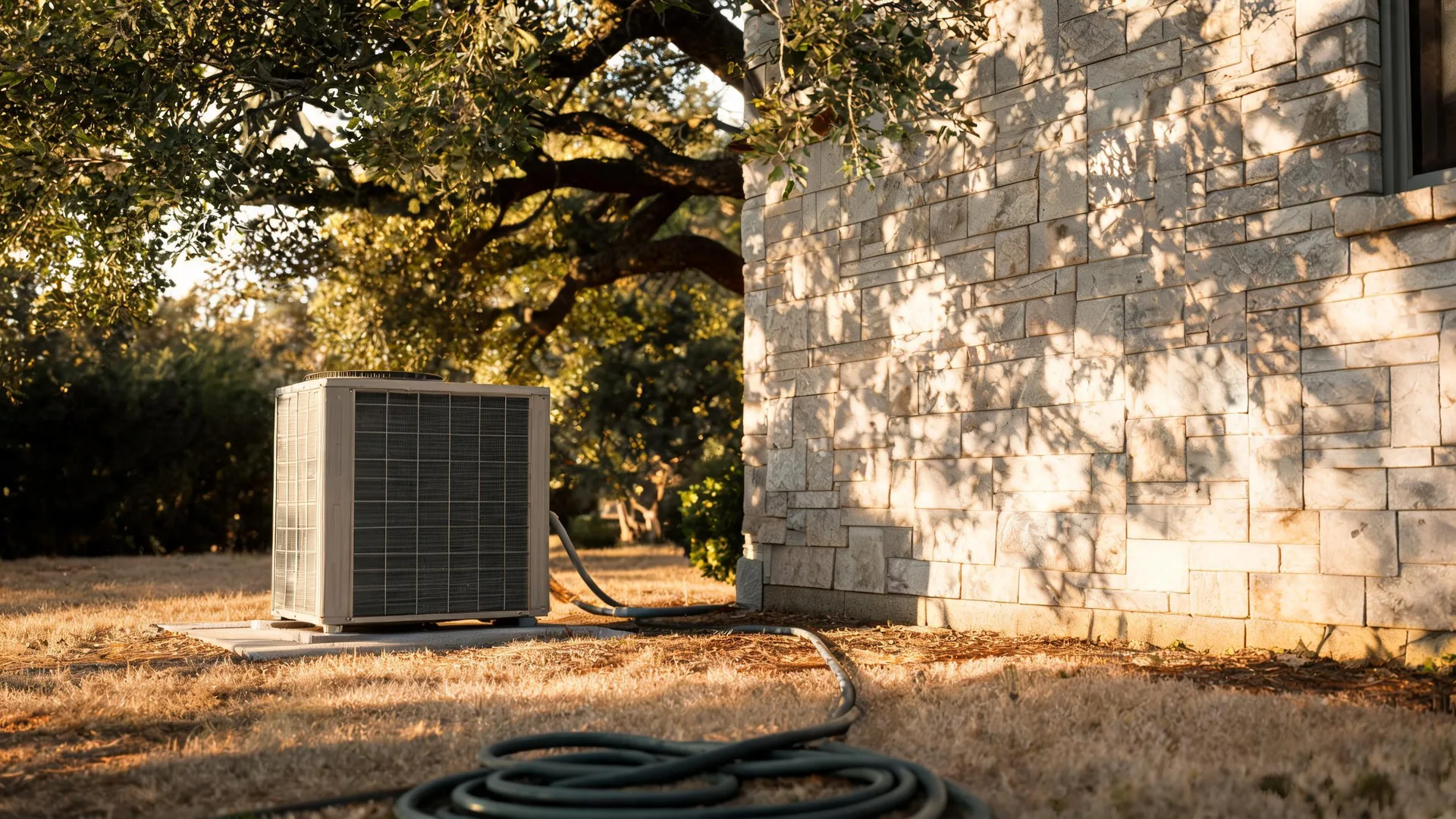
Before anyone comes out, look at the outdoor unit. If the coil is packed with ice or the fan isn't turning, that's worth noting. Check your thermostat batteries and make sure it's set to the mode you want, heat or cool, since a thermostat stuck between modes can look like a bigger problem than it is. Go to your breaker panel and see if anything tripped. Look at the air filter. A filter clogged with dust chokes airflow across the indoor coil, and that alone can cause icing or weak output. Walk around the outdoor unit and clear away leaves, grass clippings or anything blocking the sides. Listen for a buzzing sound with no air moving, or a clicking that repeats without the system starting. Those are things worth telling the tech before they arrive. Don't take any panels off the unit yourself or touch the wiring.
A heat pump that grinds, rattles or clangs during startup usually has a problem with the fan motor or a loose part inside the cabinet. A hissing sound can mean a refrigerant leak. A repeated clicking where the system tries to start and gives up points to a failing capacitor or a control board that isn't getting what it needs. None of these get better on their own, and running the system while they're happening can turn a worn part into a damaged one.
A heat pump that shuts off a few minutes after starting, then kicks back on, is called short cycling, and it puts more wear on the compressor than a system that runs a full cycle and rests. Left alone, it tends to end in a compressor replacement instead of a simpler fix. Catching it early, when it's a sensor or a refrigerant charge issue, is a smaller job than catching it late.
A heat pump that's low on refrigerant will keep trying to hit the temperature you set, and the compressor just works harder to get there. That extra effort shows up as heat, and heat is what damages a compressor over time. Ice on the outdoor coil does something similar if you let it build. The system keeps calling for the same cycle even though airflow across that coil is blocked, so it strains to move heat it can't actually move. A reversing valve that's starting to stick is often worse the second time it tries to switch than the first. Each cycle it fails to seat properly can wear the seat further, so a part that was merely stuck can end up stuck for good. None of these fix themselves by giving the system more time to run.
Whether a repair makes sense comes down to what broke and what it's connected to. A capacitor, a sensor, a contactor, these are small parts that fail on their own, and swapping one doesn't put stress on anything else in the system. A compressor is different. It's the heart of the heat pump, and when it's failing, the question isn't just the cost of that part, it's whether the rest of the system is old enough that the next thing will go soon after. A tech can tell you which kind of repair you're looking at once they've opened the cabinet. If a system has needed a few service calls in the last couple of years for unrelated problems, that pattern matters more than any single repair. One fix is just a fix. A string of them is a system telling you it's tired.