Stone and timber luxury homes with glowing windows line a mountain street at dusk, with evergreen trees and a rocky mountain range in the background.

Heat Pump Repair in Orofino, ID

Tell us about the job

Takes about a minute. No obligation.

RepairHeat PumpClearwater County, ID
Step 1 of 2

What ZIP code is the job in?

Heat starts in September here

Heat pumps in Clearwater County start carrying the heat load in September, after months of sitting idle or running cooling only. A part that was already marginal tends to fail once it has to work hard again, not while it was resting.

August is worth a look

If a heat pump struggled last winter or short cycled near the end of the season, August is the time to get it checked before September's demand hits it. Waiting until the first cold morning means diagnosing the problem while the house is already cold.

10 months
September through June, your system heats
22°F
the average winter night it heats against
76°F
the average summer afternoon it cools against
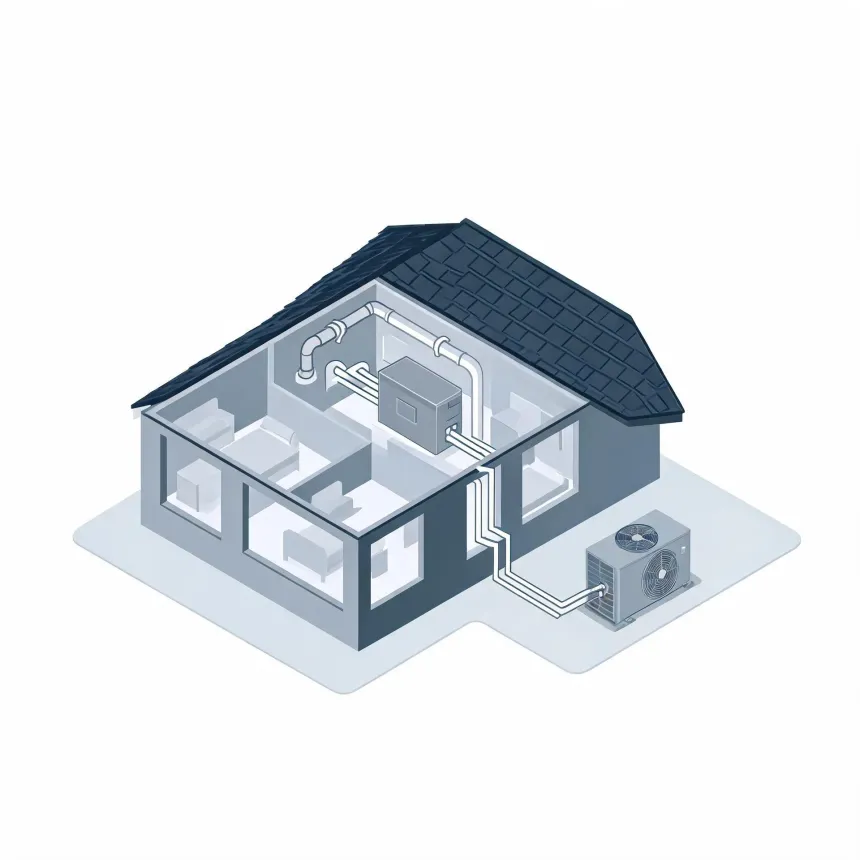
Isometric cutaway illustration of a gray house showing interior rooms, a central air handler with ducts in the attic, and refrigerant lines running to an outdoor condenser unit beside the building.

Winters here average 22 degrees overnight, not the deep freeze other places see, and hail only hit Clearwater County 6 times in the last ten years.

A heat pump that isn't fighting extreme cold or hail damage year after year is usually still in decent shape underneath, so repair is worth a real look.

Power costs the same here as anywhere else in Idaho

Power costs 11.52 cents a kWh statewide
6 hail events from 2015 to 2024
56 winter storms from 2015 to 2024
Nothing unusual about these homesHalf the homes here were built in 1977 or earlier, and mobile homes make up a fifth of the county.

So if your heat pump is acting up, get the actual problem diagnosed before you plan on replacing the whole unit. A contractor can check the reversing valve, the defrost board, the capacitor, whatever's actually failing, and tell you if it's a straightforward fix. Winter storms roll through Clearwater County often, 56 times between 2015 and 2024, but that's snow and ice piling up outside, not the system straining against bitter cold. A unit that's been through winters like that without being pushed to its limit usually has a lot of life left once the one bad part is replaced.

Get it looked at early

Problems tend to show up in the first weeks of the season, when the load hits a part that was already weak.

Find a contractor
A man in a cap, dark t-shirt and work trousers carries a canvas tool bag up porch steps toward a blue front door, with a tall planter and shrub beside the entry.
A gray air-source heat pump mounted on a concrete pad next to a house with gray vinyl siding, surrounded by gravel and flanked by green shrubs and white hydrangea flowers.

What a failing heat pump sounds and feels like

A heat pump that's struggling makes noise about it before it quits outright. Listen for the outdoor unit running longer than it used to, or cycling on and off more than it settled into before. In heating mode, warm air that feels lukewarm instead of warm often points to a reversing valve that's not fully shifting, or a compressor losing its ability to keep up. Ice building up on the outdoor coil and staying there, instead of clearing during the normal defrost cycle, usually means the defrost board or a sensor has stopped doing its job. A unit blowing cold air during what should be a defrost cycle, or one that defrosts constantly without ever needing to, is worth a call either way. Hissing or bubbling near the lines can mean a refrigerant leak, and that's not something that gets better on its own. None of these mean the whole system is done. Most of the time it's one part that's failed or is failing, and the rest of the unit is fine once that part is replaced.

Most failures start with one part

The reversing valve, the defrost board, the run capacitor and the contactor do the most switching of any parts in the system, so they wear first. A compressor rarely fails on its own. It usually fails because one of these smaller parts quit first and left it running outside the conditions it was built for.

Moving parts fail from cycling, not age alone

A heat pump that short cycles, turning on and off instead of running a full cycle, puts more wear on the contactor and capacitor than one that runs steady. Dirty coils or a weak capacitor force the system to work harder to hit the same temperature, and that extra strain is what wears out the next part down the line.

A heat pump that's losing capacity will usually still run, and that's the problem. It keeps cycling on, trying to hit the setpoint, and whatever's already weak keeps taking the strain instead of getting a break. A failing capacitor under extra load heats up and degrades faster. A compressor forced to run outside its normal range wears in ways it won't recover from. Ice that isn't clearing off the outdoor coil blocks airflow, so the system pulls harder and the defrost cycle has even more work to do next time. None of this reverses itself once the unit is shut off and left alone. The part that's struggling needs to be found and replaced, not outlasted.

A diagnostic visit starts with what the system is doing, not with guesswork. A tech runs the heat pump through a cycle and watches where it struggles, whether that's start up, the switch into defrost, or holding a steady temperature once it gets there. Gauges go on the lines to check refrigerant pressure, since too little or too much points to different problems. The reversing valve gets tested on its own, because a valve that's stuck halfway can mimic a compressor problem without being one. Electrical parts, the capacitor, the contactor, the defrost board, get checked under load, since some only show a fault when they're actually working rather than sitting idle. By the end the tech can usually point to the one part that's failing and explain what it's doing to the rest of the system.