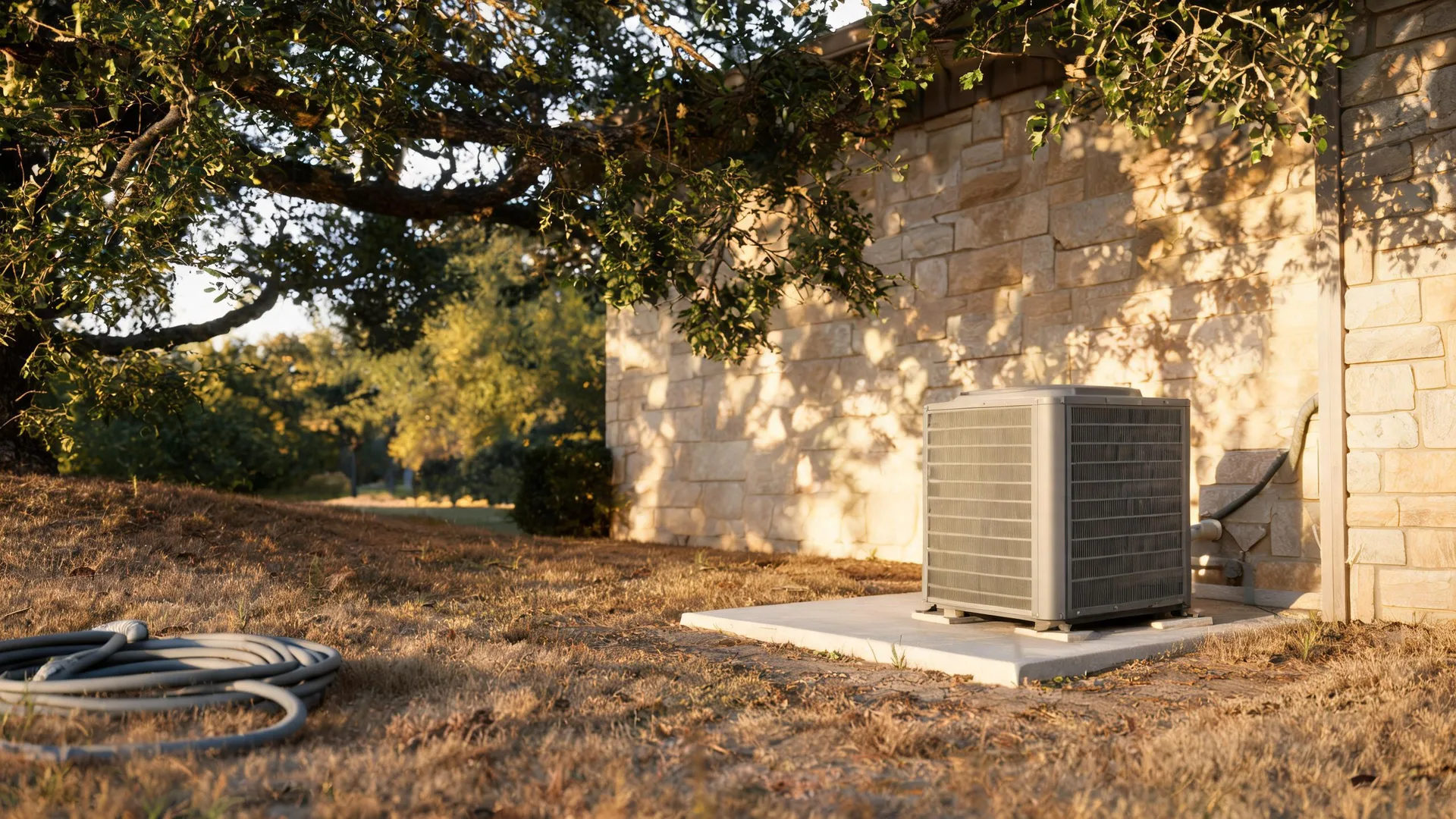
A grey outdoor HVAC unit mounted on a concrete pad beside the beige-sided exterior wall of a suburban house.

Heat Pump Repair in McCall, ID

Tell us about the job

Takes about a minute. No obligation.

RepairHeat PumpValley County, ID
Step 1 of 2

What ZIP code is the job in?

Cold nights, nothing unusual

McCall gets down to 13°F on an average winter night, and that's what a heat pump here works against all season. Units installed for this area are sized for that cold. When one starts falling behind, the cause is almost always a worn part or a setting off, not the weather outside.


What that means for the fix

A heat pump struggling to keep up usually traces back to something specific. Low refrigerant. A failing defrost control. A reversing valve stuck in one position. Find which one it is and the repair is straightforward. The cold here doesn't change that.

13°F
the average winter night it heats against
74°F
the average summer afternoon it cools against
Isometric line illustration of a cutaway single-story house showing interior rooms with beds and furniture, ceiling ductwork connected to an indoor air handler, and an outdoor condenser unit linked by refrigerant lines.

Electricity in Idaho ran 11.52 cents per kilowatthour in 2024.

A heat pump that's losing efficiency costs more every month it runs that way, so a stuck valve or low charge is worth tracking down now.

Half the homes here were built in 1992 or later, so the heat pump is probably newer too

Half the homes here were built by 1992
31 winter storms from 2015 to 2024
Winter nights average 13°F

Half the homes here were built in 1992 or later, and a heat pump doesn't wear out on a schedule tied to the house. If yours came with a newer build, it's probably within its working life still, and a repair is worth doing rather than weighing against a full replacement. A contractor can confirm the install date and check the unit's condition against it. That's a quicker call to make than guessing from how the system sounds or how old the house feels.

Get the usual fix

Nothing about this area is especially hard on it. It's most likely the usual problem with the usual fix.

Find a contractor
A man in a cap, dark jacket and tan pants walks up porch steps toward a navy blue front door, carrying a canvas tool bag filled with hand tools, with a potted plant in a blue planter to the right.
A gray air-source heat pump mounted on a concrete pad next to a house with gray vinyl siding, surrounded by gravel and flanked by green shrubs and white hydrangea flowers.

It works every month, not just one season

A heat pump doesn't get a season off. It heats all winter and cools all summer, so it racks up more run hours than a furnace or an AC that each only work part of the year. That matters because the parts that wear are the parts that move, and on a heat pump more of them are moving more often. The reversing valve switches the system between heating and cooling, and if it's sticking, the unit blows cold air when it should be heating or won't switch over cleanly. The defrost control cycles the outdoor coil to keep frost off it, and if that board or sensor fails, ice builds up and stays. A unit that short cycles, kicking on and off in quick bursts, is usually low on refrigerant or getting a bad signal from a failing sensor. None of this means the system is wearing out. It means the fix is almost always one specific part doing its job wrong, not the whole unit giving out.

What you can check yourself

Look at the outdoor unit first. If it's caked in ice beyond the thin frost that normally melts off in a defrost cycle, that's worth noting. Check that nothing is blocking the airflow around it, no leaves, no snow piled against the side. Inside, replace the air filter if it's dirty. A clogged filter starves the system of airflow and can cause problems that look like bigger failures. Check the thermostat is set to heat and the batteries aren't dead if it's a battery model. Check your breaker panel for a tripped breaker before assuming the unit itself failed.

What tells you to stop and call someone

If the outdoor unit is solid with ice and not clearing on its own, or if you hear it short cycling, turning on and off every few minutes, don't keep running it. Running a unit through a real fault can turn a small repair into a bigger one. Same goes for air blowing cold when it should be warm for more than a few minutes at a time, that's the reversing valve, and it's not something to diagnose further yourself. Past the filter, the breaker and the thermostat setting, the rest is a job for someone with gauges and training, not a screwdriver.

A heat pump low on refrigerant doesn't just run less efficiently, it runs cold on purpose. The compressor relies on refrigerant to carry heat and to keep itself cooled while it works. Run it low long enough and the compressor itself starts taking the damage, not just the charge level. Ice on the outdoor coil behaves the same way. A little frost clears in a normal defrost cycle. Ice that stays and builds blocks airflow across the coil, and the system compensates by working harder to pull in the heat it needs, which packs on more ice. Short cycling wears on the compressor too, since the hardest pull on any motor is the moment it starts, and a unit doing that every few minutes is starting far more often than it should. None of these faults fix themselves by running longer. They get fed by it.

A diagnostic visit starts outside at the unit itself, checking the coil for ice, the fan for obstruction, and the refrigerant lines for signs of a leak. Gauges go on next to check the charge, since low refrigerant shows up as a pressure reading before it shows up as anything you can hear or see. Inside, the thermostat gets checked against what the system is actually doing, because a call for heat that isn't reaching the air points to the reversing valve, not the thermostat itself. The defrost control gets tested too, since a board that isn't triggering the defrost cycle on schedule will let ice build back up within a day even after it's cleared. Electrical connections get checked at the compressor and the contactor, since a loose or corroded connection can cause the same short cycling that a bad sensor does. By the end, the fault should be narrowed to one part, not a general sense that the unit is struggling.