






A paved road lined by a rustic wooden log fence and gravel leads past a row of dark-clad cabins with metal gable roofs among tall conifer trees under an overcast sky.

Heat Pump Repair in Idaho Falls, ID

Tell us about the job

Takes about a minute. No obligation.

RepairHeat PumpBonneville County, ID
Step 1 of 2

What ZIP code is the job in?

Overnight lows here average 15°F across December, January and February. A heat pump works hard on nights like that, but that's normal duty for the system, not a sign it was installed wrong. When one struggles in that cold, the cause is usually ordinary. Low refrigerant charge. A failing defrost control. A reversing valve stuck in one position. Heavy snow or ice piling up around the outdoor unit can block airflow and cause the same symptoms, and winter storms do hit this county often enough to matter. None of that means your system or your house is unusual. It means the fix is the same one a tech would make on this problem anywhere.

10 months
September through June, your system heats
15°F
the average winter night it heats against
77°F
the average summer afternoon it cools against
Isometric illustration of a cutaway single-story house showing interior ductwork and an air handler connected by lines to an outdoor condenser unit on a pad beside the building.

Heat here starts up in September and runs clear through June.

August is the month to get a heat pump looked at, before the first cold night finds the weak part.

Nothing here works a heat pump harder than normal

Power costs 11.52 cents a kWh statewide
118 damaging wind events from 2015 to 2024
20 hail events from 2015 to 2024
Idaho Falls homes are young, and so are most of their systemsHalf the homes in Bonneville County were built in 1985 or later

A heat pump in trouble usually tells you before it quits outright. Air coming from the vents that feels barely warm, or just cool, is the first thing most people notice, since this system heats with warm air, not hot air, and a weak stream feels wrong fast. Listen for it running long stretches without shutting off, or short cycling on and off every few minutes. Both point to the same family of problems, just from different directions. Ice building up on the outdoor unit and staying there is another one. Some frost in cold weather is normal, the unit melts it off on its own a few times a day. Frost that just sits and thickens means the defrost cycle isn't doing its job. A hissing sound near the lines or oil spots on the ground near the outdoor unit usually means refrigerant is getting out somewhere it shouldn't. Any of these is worth a call before it turns into a system that won't heat at all.

A newer system is worth repairing

If your heat pump came with the house, there's a good chance the house itself is newer, and the system with it. A system still within its working life is usually worth repairing, not replacing. Worth having someone check it out and tell you which part needs the work.

Find a contractor
A man in a cap, gray T-shirt and tan work pants climbs porch steps toward a blue front door, carrying a canvas tool bag filled with tools, beside a blue planter with a shrub.
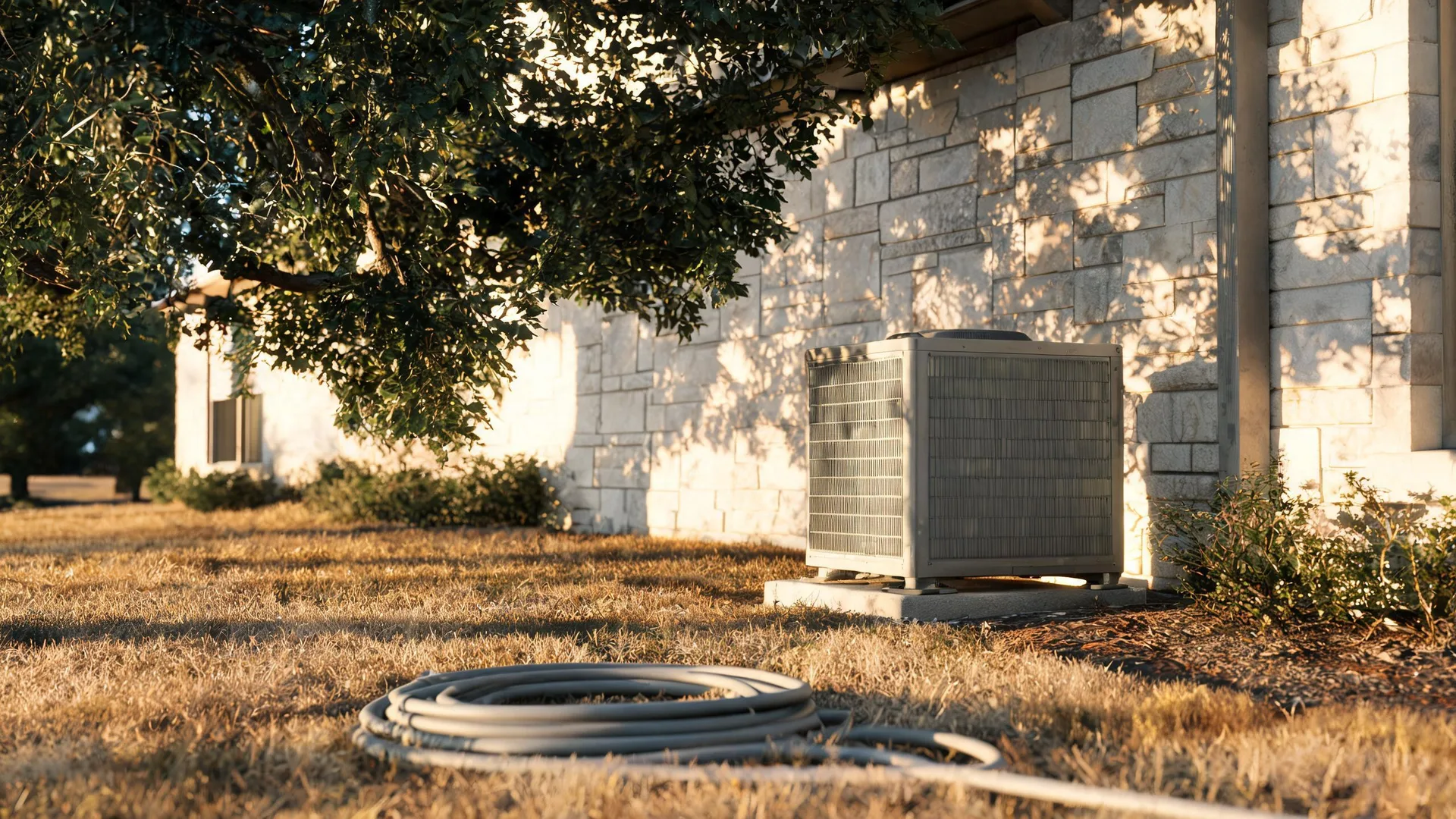
A gray heat pump outdoor unit mounted on a concrete pad next to a residential house with lap siding and stone accents.

A problem that runs all night doesn't stay the same size

A heat pump that's struggling doesn't rest when you leave it running, it just keeps working against whatever's wrong. Low refrigerant charge means the compressor runs longer to move the same heat, and it runs hot doing it. That shortens its life. A reversing valve stuck halfway makes the system fight itself, drawing power without delivering warm air. Frost left to thicken on the outdoor coil blocks airflow more each hour, so the unit pulls harder for less heat until it can't pull enough. None of these fix themselves by running more. They get worse on the same slope they started on, and the part that was failing slowly starts failing fast.

Check the thermostat and the breaker first

Make sure it's set to heat and the temperature is actually above room temperature. Check the breaker panel for a tripped switch on both the indoor and outdoor unit circuits. Flip it back once and see if it holds. If it trips again right away, stop and leave it for a tech.
Look at the outdoor unit itself

Walk outside and check that nothing is blocking it. Leaves, a fallen branch, or snow piled against the sides can choke off airflow and cause the same symptoms as a real mechanical problem. Clear away anything stacked against it, but don't chip at ice stuck to the coil. That takes a tech, not a scraper.

Most heat pump failures trace back to a handful of parts, and they fail for ordinary reasons. The reversing valve is a common one. It switches the system between heating and cooling, and the coil inside it wears out from switching back and forth thousands of times over the years. A run capacitor weakens slowly, giving the compressor or fan motor less of a kick each time it starts, until one day it doesn't start at all. Refrigerant doesn't get used up, so if the charge is low, it's leaking out somewhere, usually at a fitting or a joint in the line. The defrost control board can fail too, either stuck thinking it's always time to defrost or never calling for it, and either way the outdoor coil suffers for it. None of these are about one bad install or one bad unit. They're just what gives out on a machine that cycles on and off, and runs in both directions, for years at a stretch.

A diagnostic visit starts outside, at the unit itself, before any panel comes off. A tech checks the refrigerant pressure, the temperature of the air going in against the air coming out, and the amp draw on the compressor and fan motor. Those readings usually point straight at the problem or rule out most of the list fast. If the pressures are off, the next step is finding where refrigerant is getting out, usually with an electronic leak detector run along the fittings and joints. If the electrical readings are off, the capacitor and the contactor get tested directly, since both are quick to check and both fail often. The reversing valve and defrost board get tested by forcing the system through a cycle and watching whether they respond the way they should. None of this takes guesswork once the readings are in hand. The readings tell the tech which part is failing, and that's what gets written up before anything gets replaced.