







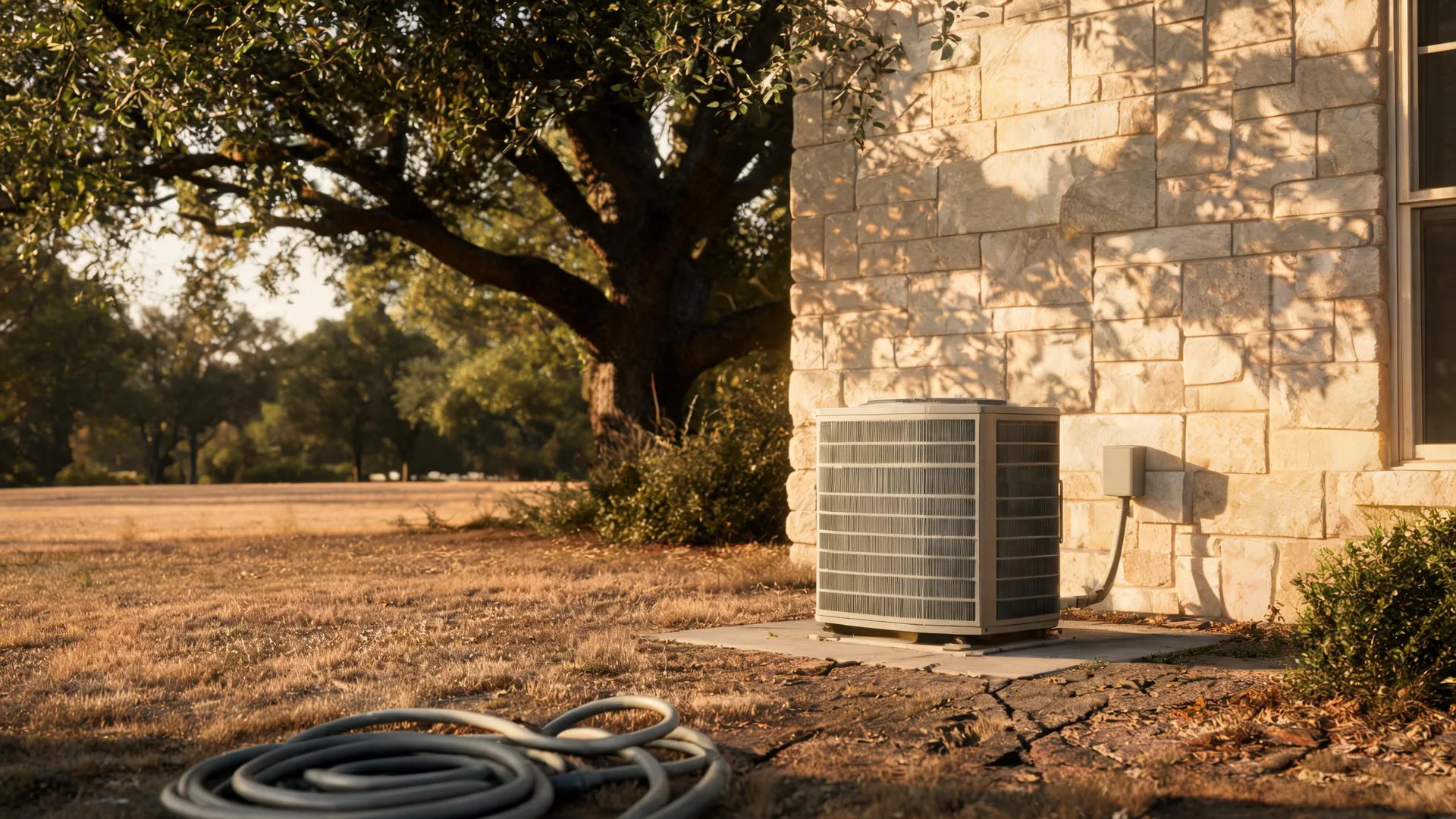
An outdoor air conditioning condenser unit mounted on a concrete pad next to a residential house at sunset.

Heat Pump Repair in Emmett, ID

Tell us about the job

Takes about a minute. No obligation.

RepairHeat PumpGem County, ID
Step 1 of 2

What ZIP code is the job in?

Half the homes in Gem County were built in 1983 or later, which puts a lot of the heat pumps in Emmett on newer ductwork and newer electrical. That matters when something goes wrong. A heat pump acting up in a house built in the last few decades is usually a repair, not a sign the whole system is done. Worth checking when yours was installed, since if it came in with a newer build, it's probably got good years left in it.

8 months
October through May, your system heats
2 months
July through August, it cools
23°F
the average winter night it heats against
85°F
the average summer afternoon it cools against
Isometric illustration of a cutaway single-story house showing interior ductwork, an indoor air handler and simple furniture, connected by lines to an outdoor condenser unit beside the building.
Your system heats October through May and cools July through August.

NOAA nClimDiv, 1991–2020 normals

Winter nights in Gem County average 23°F, not far below freezing.

A heat pump here isn't fighting deep cold for months on end, so parts tend to last.

October is when a weak heat pump shows it

Cooling runs July through August
Heat runs October through May
68 winter storms from 2015 to 2024
A newer countyHalf of Gem County's homes were built in 1983 or later.

That's worth knowing before you decide whether to fix what you've got. A heat pump that's spent its life working moderate temperature swings instead of brutal cold usually hasn't been pushed hard on its compressor or its reversing valve. So if yours is short cycling, blowing cool air, or not keeping up, the cause is more often a failed capacitor, a low charge, or a stuck valve than a system that's worn out. Those are repairs a contractor can usually make in one visit. Worth getting it looked at before assuming you need a new unit.

Repair it

If your system came with a newer house, it likely has plenty of life left. Repair is usually the right call.

Find a contractor
A man in a cap, dark long-sleeve shirt, tan work pants and boots walks up wooden porch steps toward a teal front door, carrying a canvas tool bag with hand tools.
A gray outdoor HVAC unit mounted on a concrete pad beside a house with gray lap siding and a stone foundation.

What you'll notice before you know what it is

A heat pump doesn't fail all at once. Most of the time you notice it in pieces first. The air coming out of the vents feels wrong for the setting it's on. The outdoor unit runs longer than it used to, or it shuts off and restarts more often than it should. Some mornings there's frost on the outdoor coil that doesn't clear on its own. Each of those is small by itself, and each one is also the system telling you something specific. The trouble is it doesn't stop telling you. A system that short cycles today will short cycle more next month, and the wear that causes adds up whether or not you're paying attention to it.

What you can check yourself

Look at the outdoor unit first. If the fan isn't spinning, make sure nothing is blocking it and check that the breaker hasn't tripped. Look at the coil for ice. A frozen coil usually means airflow is restricted somewhere, often at the filter. Pull the filter and hold it up to the light. If you can't see through it, swap it out, that alone fixes more heat pump complaints than anything else. Check the thermostat batteries and make sure it's set to the mode you think it's in, heat pumps get switched to emergency heat by accident more than people expect.
What to leave alone

Don't open the outdoor unit's cabinet or touch anything inside it. The refrigerant lines and electrical connections in there aren't something to check yourself, and a wrong guess can turn a simple repair into a bigger one. Don't add refrigerant even if you have access to it, a low charge means there's a leak somewhere, and adding more without finding it just delays the real fix. If the breaker trips more than once, stop resetting it and get someone out, a breaker that keeps tripping is telling you something is actually wrong, not asking to be ignored.

Most heat pump failures trace back to a handful of parts. The capacitor gives the compressor and fan motor the jolt they need to start, and it weakens over time until one day it can't do the job. A reversing valve can stick in one position, which is why a system stuck in cooling mode when it should be heating, or the other way around, is such a common complaint. Refrigerant doesn't get used up, so a low charge always means a leak somewhere in the lines. Contactors pit and burn from constant cycling until they stop making good contact. Sensors and defrost boards fail too, and when they do the system can't tell when to switch modes or clear ice off the outdoor coil. None of these are failures of the whole machine, they're individual parts wearing out on their own schedule.

A diagnostic visit starts outside, at the unit itself. A contractor checks for airflow, listens to how the compressor sounds on startup, and checks the pressures on both the high and low side of the system. That tells them whether the charge is right and whether the compressor is moving refrigerant the way it should. From there they'll check the capacitor's output against what it's rated for, since a capacitor can test weak long before it fails outright. They'll run the system in both heating and cooling to see if the reversing valve actually switches when it's told to. Electrical connections get checked too, especially at the contactor, since burned contacts cause intermittent problems that don't always show up right away. By the end they can usually point to the one part causing the trouble, not just the symptom you called in about.